
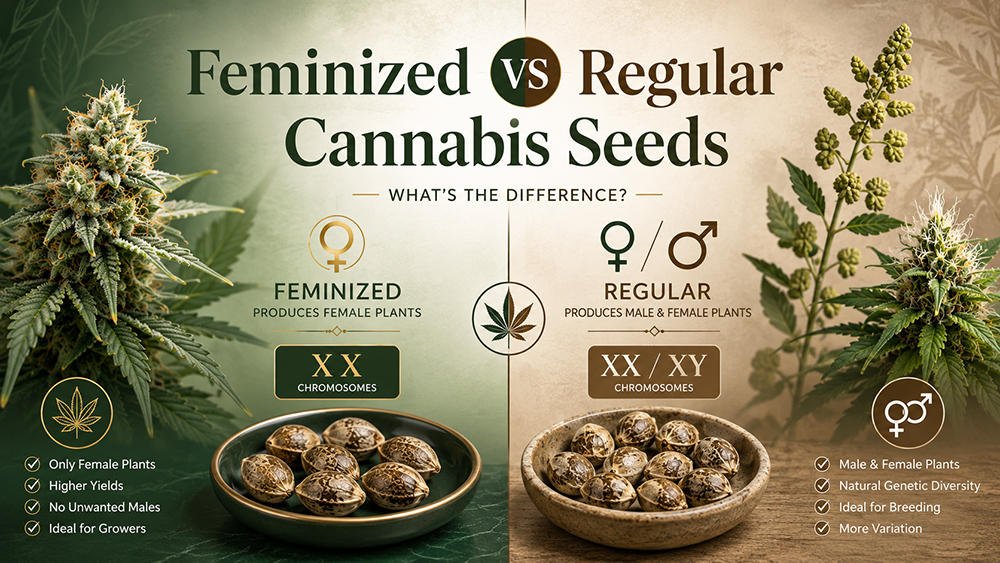
When browsing cannabis seeds, two of the most fundamental categories you’ll encounter are feminized and regular seeds.
At first glance, the difference seems straightforward. Regular cannabis seeds can produce male or female plants, whereas feminized cannabis seeds are specifically bred so that the resulting genetics are overwhelmingly female.
But when we look more closely at feminized vs regular cannabis seeds, there is considerably more going on behind the scenes.
The difference comes down to cannabis sex chromosomes, the way breeders produce seed and, ultimately, what the genetics are intended for.
For collectors interested in understanding modern cannabis breeding, knowing the distinction between feminized and regular seeds provides a useful foundation for everything from F1 hybrids and S1 seeds to autoflowering and specialist breeding lines.
What Are Regular Cannabis Seeds?
Regular cannabis seeds are produced through traditional sexual reproduction involving male and female cannabis genetics.
Cannabis is primarily a dioecious species, meaning male and female flowers normally occur on separate plants. At the chromosome level, female cannabis plants generally carry XX sex chromosomes, while male plants carry XY chromosomes.
When pollen from a conventional male fertilises a female plant, the resulting seeds can inherit either:
XX = genetically female
or
XY = genetically male
As a result, a population of regular cannabis seeds will normally contain both male and female individuals.
Research on cannabis sex expression has observed approximately 1:1 male-to-female ratios from conventional seed production, which is what would be expected from the XX/XY chromosome system. Individual seed packs shouldn’t necessarily be expected to produce an exact 50/50 split because chance still plays a role in a small sample.
That natural mixture is what defines regular cannabis seeds.
What Are Feminized Cannabis Seeds?
Feminized cannabis seeds are produced using a different breeding process designed to avoid the introduction of a Y chromosome.
Rather than using pollen from a genetically male XY plant, breeders induce a genetically female XX plant to produce pollen-bearing male flowers.
That pollen still originates from an XX female plant.
Because there is no Y chromosome present in that pollen source, fertilisation between the induced female pollen donor and another female plant can produce XX offspring.
This forms the biological basis of feminized seed production.
Modern scientific research into cannabis breeding has investigated several substances capable of altering floral sex expression. Silver thiosulfate (STS) is one of the most widely studied and effective tools for inducing pollen-producing flowers on genetically female cannabis plants.
The result is seed expected to produce overwhelmingly female genetics.
Are Feminized Cannabis Seeds 100% Female?
You’ll often see feminized seeds described as 100% female.
From a marketing perspective, this communicates their intended purpose, but biologically we’d prefer slightly more careful wording.
Properly produced feminized cannabis seeds are designed to produce female plants with an extremely high level of reliability, but cannabis sex expression is more complicated than simply looking at XX and XY chromosomes.
Research shows that cannabis has considerable sexual plasticity. Environmental conditions, hormonal signalling and genetic factors can influence floral sex expression, and genetically female XX cannabis can under some circumstances develop male flowers.
This is why at SeedMasters.com we prefer describing quality feminized seeds as highly reliable female genetics rather than making an absolute biological guarantee.
The distinction might be small, but it’s more accurate.
How Are Feminized Cannabis Seeds Made?
The underlying concept is surprisingly elegant.
A conventional regular cross might look like this:
Female XX × Male XY
The female contributes an X chromosome.
The male pollen can contribute either X or Y.
The offspring can consequently be:
XX female
or
XY male
Feminized seed production changes the pollen source.
Instead, a breeder works with a genetically female XX plant and induces it to develop functional pollen-bearing flowers.
The cross effectively becomes:
Female XX × Female-derived XX pollen
Both parents can provide only X sex chromosomes.
The resulting seeds therefore receive:
X + X = XX
This is why feminized seeds can be produced without using a conventional male cannabis plant.
Studies have successfully demonstrated this process using chemically induced male flowers on genetically female cannabis plants, producing viable pollen and feminized seed.
Why Is Silver Thiosulfate Used in Cannabis Breeding?
One of the important biological mechanisms involved in cannabis sex expression is the plant hormone ethylene.
Silver-based compounds can interfere with ethylene signalling.
Silver thiosulfate, generally abbreviated to STS, has consequently become an important research and commercial breeding tool for inducing male flowers on genetically female cannabis plants.
Studies published in Frontiers in Plant Science, Plants and other peer-reviewed journals have demonstrated the effectiveness of STS for inducing male flowering and producing feminized cannabis seed.
This is professional plant breeding rather than a genetic modification of the plant’s DNA.
The female remains genetically XX. What has changed is the expression of its flowers.
That distinction is important when understanding how feminized cannabis seeds are created.
Feminized vs Regular Cannabis Seeds: The Main Difference
At the simplest level, the difference is:
Regular cannabis seeds: contain naturally produced male and female genetics.
Feminized cannabis seeds: are specifically produced so that the resulting seed population is overwhelmingly genetically female.
But that basic distinction creates several other differences between the two categories.
Feminized vs Regular Cannabis Seeds at a Glance
| Characteristic | Feminized Seeds | Regular Seeds |
|---|---|---|
| Female genetics | Overwhelmingly | Approximately half naturally |
| Male genetics expected | Very uncommon | Yes |
| Typical sex chromosomes | XX | XX or XY |
| Conventional male parent required | No | Yes |
| Suitable for preserving male genetics | No | Yes |
| Useful within breeding programmes | Yes | Yes |
| Useful for traditional male × female breeding | Limited | Yes |
| Available as autoflowers | Yes | Yes |
| Available as photoperiod genetics | Yes | Yes |
Neither category is inherently superior.
They simply have different purposes.
Genetic Diversity: Regular vs Feminized Cannabis Seeds
One of the biggest differences people often associate with regular and feminized cannabis seeds is genetic diversity. Regular seeds are commonly favoured by breeders because they provide both male and female genetics, making them useful for preserving and developing different cannabis lines.
However, this doesn’t automatically mean regular seeds contain more genetic variation than feminized seeds.
The amount of diversity within a strain depends largely on its parentage and how carefully the breeder has developed the genetic line. Some varieties contain a wide range of inherited characteristics, while others have been selectively bred to produce more consistent results.
This is where inbred lines (IBLs) come into the picture. These are genetic lines developed over multiple generations to make particular characteristics more predictable. You can learn more about this process in our guide to IBL cannabis strains.
Ultimately, whether seeds are regular or feminized is only part of the story. Their genetic background and the breeding work behind them are far more useful indicators of how much variation a particular strain may contain.
Why Are Feminized Cannabis Seeds So Popular?
Feminized seeds have transformed the commercial cannabis seed market.
Before reliable feminization techniques became widespread, regular seeds were essentially the default format for cannabis genetics.
Collectors buying a seed population received both male and female genetics.
Feminization allowed breeders to offer the female expression of a particular strain in a much more predictable format.
That is especially useful when the characteristics people associate with a particular cannabis variety — cannabinoid profile, terpene expression, resin production, flower structure and colour — have been selected primarily from female plants.
Today, many major seedbanks consequently offer much of their catalogue as feminized cannabis seeds.
Why Do Regular Cannabis Seeds Still Matter?
If feminized seeds are so convenient, you might reasonably ask why regular cannabis seeds still exist.
The answer is breeding and genetic diversity.
Male cannabis genetics remain enormously important to traditional cannabis breeding.
A breeder creating a conventional cross requires pollen, and regular seeds provide access to both sides of the genetic population.
This can allow breeders to evaluate:
- Male characteristics
- Female characteristics
- Genetic diversity
- Family traits
- Inheritance patterns
- Potential parental combinations
Regular seeds are therefore particularly important within breeding programmes and genetic preservation projects.
Many respected breeders continue to work extensively with regular genetics for precisely this reason.
Are Regular Cannabis Seeds More Natural?
You’ll sometimes hear regular seeds described as “more natural”.
There is some logic behind the phrase because conventional regular seed production involves the normal male-to-female reproductive system of dioecious cannabis.
However, that doesn’t mean feminized seeds are somehow artificial or genetically modified.
Both are Cannabis sativa seeds produced through sexual reproduction.
The difference lies primarily in where the pollen comes from.
Regular seeds generally involve:
XX female × XY male
Feminized seeds involve pollen produced by:
XX female × XX female-derived pollen
Feminization manipulates sex expression, not the fundamental genetic identity of cannabis as a species. Peer-reviewed studies have repeatedly demonstrated the production of viable pollen from genetically female plants through hormonal manipulation of floral development.
Are Feminized Seeds Genetically Modified?
No — not in the conventional meaning of genetically modified organism (GMO).
Producing feminized cannabis seeds does not normally involve inserting foreign genes or directly editing DNA.
Instead, breeders temporarily manipulate floral sex expression on a genetically female plant so that it produces pollen.
Its sex chromosomes remain XX.
That distinction is why terms such as sex reversal or masculinisation of female plants are commonly used in scientific research into feminized seed production.
Can Feminized Cannabis Seeds Be Used for Breeding?
Yes.
There is a common misconception that feminized genetics somehow cannot be used in breeding programmes.
They can.
In fact, feminization has become an important breeding technique in modern cannabis development.
One particularly relevant example is the S1 generation.
S1 stands for first selfed generation.
A breeder can induce pollen production on a selected female and use that pollen to fertilise the same genetic individual or another genetically identical copy.
The resulting offspring are described as S1 seeds.
This technique allows breeders to investigate and preserve particular female genetics without introducing a conventional male parent.
We’ll cover this in more detail in our separate guide to S1 cannabis seeds.
Regular Seeds and Traditional Cannabis Breeding
Regular cannabis seeds remain particularly important when breeders want to work with conventional male and female populations.
Male plants can carry valuable genetic characteristics even though they don’t express flowers in the same way as females.
A breeder might evaluate males based on factors including:
- Family history
- Structure
- Flowering behaviour
- Aroma
- Pollen production
- Genetic markers
- Characteristics expressed by related offspring
The selected male can then contribute half of the genetic material to the next generation.
This traditional approach has been responsible for an enormous proportion of the cannabis strains that ultimately became modern classics.
Do Feminized Seeds Have Less Genetic Diversity?
Not necessarily.
This is another area where the terminology can become misleading.
Feminized describes the sex composition of the seeds.
It does not tell you how genetically diverse or genetically uniform the strain is.
A feminized seed population can still contain considerable phenotype variation.
Likewise, a regular seed line can be either highly uniform or extremely diverse depending on the breeding history behind it.
Genetic uniformity is influenced by factors such as:
- Parental selection
- Inbreeding
- Backcrossing
- Number of generations
- Population size
- Selection pressure
- Breeding strategy
This is why terms such as F1, F2, S1, BX and IBL tell us something different from the word feminized.
Our guide to What Are F1 Cannabis Seeds? explores this distinction in considerably more detail.
Feminized Doesn’t Mean Autoflowering
Another common source of confusion is the difference between feminized and autoflowering.
These terms describe completely separate characteristics.
Feminized refers to the expected sex of the genetics.
Autoflowering refers to flowering behaviour.
A seed can therefore be:
Feminized + Photoperiod
or:
Feminized + Autoflowering
Likewise, regular autoflowering seeds can exist.
The categories overlap rather than replace one another.
The same principle applies to Fast Flowering genetics, which remain photoperiod-dependent despite often containing autoflower ancestry. We explore this separately in our guide to Fast Flowering vs Autoflowering Cannabis Seeds.
Feminized Doesn’t Mean F1 Either
The same applies to F1 hybrids.
An F1 label describes the generation of a genetic cross.
Feminized describes the expected sex composition.
A cannabis seed can therefore be:
F1 + Feminized
F1 + Regular
F1 + Feminized + Autoflowering
or several other possible combinations depending on the breeder’s programme.
Understanding each term individually makes modern cannabis seed catalogues much easier to navigate.
Which Is Better: Feminized or Regular Cannabis Seeds?
When comparing feminized vs regular cannabis seeds, there really isn’t a universal winner.
The best category depends entirely on what you’re interested in.
Feminized seeds make sense for collectors interested in:
- Female versions of established strains
- Modern commercial cannabis genetics
- Predictable female genetic expression
- Large selections from mainstream seedbanks
- Feminized photoperiod and autoflower varieties
Regular seeds are especially interesting for collectors interested in:
- Traditional cannabis breeding
- Male and female genetics
- Genetic preservation
- Older breeding lines
- Exploring complete genetic populations
From a breeding perspective, both formats are valuable.
One offers highly predictable access to female genetics.
The other preserves the conventional male-and-female population structure of cannabis.
Does Feminized Mean Better Quality?
No.
Feminized is a seed type, not a quality rating.
A poorly selected feminized strain doesn’t automatically become excellent because male offspring have been removed from the population.
Likewise, regular seeds aren’t automatically superior because they were produced traditionally.
Quality depends on far more important factors, including:
- The quality of the original genetics
- Parental selection
- Breeder experience
- Genetic stability
- Selection objectives
- Testing
- Preservation of desirable traits
This is why breeder reputation remains just as important as whether a seed is labelled regular or feminized.
Why Breeder Selection Matters
Producing feminized seeds isn’t simply a matter of generating pollen from any female plant.
The quality of the resulting genetics still depends on the plant selected as the parent.
Professional breeders may evaluate large populations before choosing individuals that represent the characteristics they want to preserve or combine.
The same applies to regular breeding.
A high-quality male is not valuable merely because it produces pollen. Its genetic contribution has to complement the female line with which it is paired.
Good cannabis breeding is therefore ultimately about selection.
Seed format comes afterwards.
Feminized vs Regular Seeds and Genetic Preservation
Both categories also have a place within cannabis genetic preservation.
Feminized seeds can preserve access to valuable female genetic combinations in seed form.
Regular seeds preserve both male and female genetics and therefore provide a broader representation of traditional sexually reproducing populations.
For older varieties, landrace genetics and specialist breeding material, regular populations can consequently be particularly valuable.
For modern commercial cultivars that were primarily developed around selected female characteristics, feminized seed can offer a practical way of maintaining access to those genetics.
Different preservation goals call for different approaches.
Feminized vs Regular Cannabis Seeds: Final Thoughts
The difference between feminized vs regular cannabis seeds ultimately comes down to sex genetics and breeding technique.
Regular cannabis seeds are normally produced using conventional male and female parents:
XX female × XY male
The resulting population can contain both:
XX females and XY males.
Feminized cannabis seeds are produced without a conventional XY male. Instead, a genetically female XX plant is induced to produce viable pollen, allowing breeders to create seed populations composed overwhelmingly of XX genetics. Scientific studies have demonstrated this principle using several sex-reversal techniques, with silver thiosulfate among the most effective and widely researched.
Neither approach makes one seed automatically better than the other.
Feminized cannabis seeds have become hugely important because they provide reliable access to female genetics and allow breeders to offer an enormous variety of modern strains in a convenient format.
Regular cannabis seeds remain equally important to the history and future of cannabis breeding because they preserve male genetics alongside females and provide the foundation for traditional breeding programmes.
Understanding the difference also makes it easier to understand other modern cannabis terminology, including F1, F2, S1, IBL, autoflowering and Fast Flowering genetics.
At SeedMasters.com, we carefully curate cannabis seeds from established and emerging breeders, covering feminized, autoflowering, regular and specialist genetics from around the world. Whether you’re interested in modern hybrids, established classics or the breeding history behind a particular variety, understanding how those seeds were created is an important part of appreciating the genetics themselves.
All cannabis seeds sold by SeedMasters.com are intended strictly as souvenirs and for genetic preservation purposes only. Please check and comply with the laws applicable in your country before ordering.


