
If you’ve spent any time looking through specialist cannabis genetics, you’ve probably encountered the letters IBL.
Unlike familiar labels such as feminized, autoflowering or regular, IBL doesn’t describe the sex of the seeds or how a plant flowers.
IBL stands for Inbred Line.
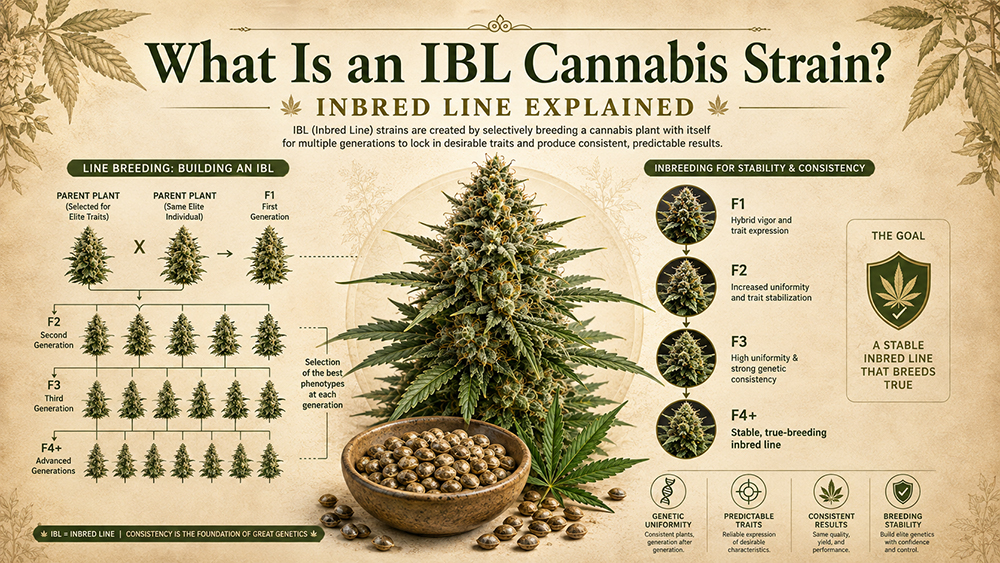
An IBL cannabis strain is a genetic line that has undergone repeated generations of breeding within a relatively narrow family, with breeders selecting particular individuals and characteristics generation after generation.
The objective is generally to make those characteristics increasingly predictable by reducing genetic variability and increasing homozygosity.
In simple terms, breeders are attempting to create a line that reproduces its defining characteristics much more consistently from seed.
That makes IBL genetics particularly important in plant breeding because highly homozygous inbred lines can also be used as parents for producing uniform F1 hybrids and exploiting hybrid vigour. Cannabis researchers have specifically discussed the development of inbred parental lines as an important step towards true F1 hybrid breeding.
But what actually makes a cannabis strain an IBL, how many generations does it take, and does IBL automatically mean stable?
Let’s look more closely.
What Does IBL Mean in Cannabis?
IBL means Inbred Line.
In plant breeding, inbreeding involves repeatedly reproducing plants that are genetically related.
Depending on the breeding system, this may involve techniques such as:
- Self-pollination
- Brother × sister or sibling crosses
- Repeated selection within the same family
- Controlled crosses between closely related individuals
Over successive generations, this reduces heterozygosity and increases homozygosity.
That distinction is central to understanding IBL genetics.
Heterozygous
A plant carries different versions of a particular gene or genetic region.
Homozygous
A plant carries matching versions inherited from each parent at a particular genetic location.
The more important characteristics become homozygous and fixed within a line, the more predictably those characteristics can potentially appear in subsequent generations.
Cannabis is naturally highly heterozygous and predominantly outcrossing, which makes developing truly uniform inbred lines more challenging than simply crossing two related plants a couple of times.
What Is the Purpose of Creating an IBL Cannabis Strain?
The primary objective is predictability.
Imagine a breeder begins with a population showing considerable variation.
Within those plants there may be differences in:
- Structure
- Flowering behaviour
- Cannabinoid profile
- Terpene expression
- Colour
- Morphology
- Vigour
- Other inherited characteristics
The breeder identifies individuals showing the characteristics they want and breeds those plants together.
The resulting offspring are evaluated again.
The best individuals are selected again.
That process continues over multiple generations.
Gradually, particular genetic combinations can become increasingly fixed within the population.
Instead of producing offspring that move in many different genetic directions, the breeder is attempting to narrow the range of possible outcomes.
That is one of the fundamental purposes of an IBL cannabis strain.
How Many Generations Does It Take to Create an IBL?
This is where cannabis terminology can become a little vague.
You’ll sometimes encounter claims that a strain becomes an IBL at F4, F5, F6 or another specific generation.
There isn’t a magic generation number that automatically turns a cannabis strain into a genuine inbred line.
What matters is the degree of homozygosity and genetic fixation achieved, not simply the number printed after the letter F.
However, repeated generations are normally required.
A peer-reviewed review discussing genetic stability in cannabis states that more than five generations of inbreeding may generally be needed to obtain a pure inbred line, while noting that relatively few hemp varieties have reached very high levels of homozygosity.
Other plant-breeding approaches can accelerate the process dramatically.
For example, cannabis researchers investigating doubled haploid technology have described the theoretical ability to create 100% homozygous inbred lines within a single laboratory generation.
For conventional breeding, though, developing a genuine IBL is normally a long-term project rather than a one-generation cross.
What Happens During Inbreeding?
To understand IBL genetics, it helps to understand what breeders are gradually changing.
Imagine a genetic location where a plant carries:
A/a
This plant is heterozygous because it carries two different versions.
Through repeated inbreeding and selection, later generations may become fixed as:
A/A
or:
a/a
Those individuals are homozygous at that location.
Repeat that process across many important regions of the genome and the population becomes increasingly genetically uniform.
The goal isn’t necessarily to make every single base pair identical.
Instead, breeders generally want to establish a predictable collection of inherited characteristics.
This is what people usually mean when they describe an IBL as breeding true.
What Does “Breeding True” Mean?
A true-breeding line produces offspring that consistently resemble the parental line for the characteristics being selected.
For example, if a breeder has successfully fixed a particular characteristic, that characteristic should appear reliably across subsequent generations.
That doesn’t mean every seed produces an absolutely identical plant.
Seed-grown plants are created through sexual reproduction, so recombination can still occur unless extremely high homozygosity has been achieved.
Environment can also influence how genetic characteristics are expressed.
It is therefore more accurate to describe a good IBL as:
highly predictable and genetically uniform
rather than:
identical like clones.
Clones are genetic copies of one selected individual.
IBL seeds remain a sexually reproduced population.
Are IBL Cannabis Seeds Identical?
No.
This is an important misconception.
An IBL population may be considerably more uniform than an early-generation hybrid, but seeds aren’t automatically genetic duplicates of one another.
Cannabis research highlights that sexual reproduction creates opportunities for recombination and segregation unless parental material is highly homozygous.
Even highly developed lines may retain some genetic variation.
The better question isn’t:
“Are all the seeds identical?”
but:
“How much genetic variation remains within the line?”
A well-developed IBL should generally have considerably less variation in its selected characteristics than a highly heterozygous population.
Why Is Cannabis Difficult to Inbreed?
Cannabis presents breeders with some particular challenges.
The species is predominantly dioecious, meaning male and female flowers usually occur on separate plants, and it is naturally highly heterozygous and outcrossing. Modern cannabis breeding literature specifically identifies these characteristics as reasons breeding and genetic fixation can be time-consuming.
Natural outcrossing encourages genetic diversity.
IBL development essentially moves in the opposite direction.
The breeder is deliberately narrowing genetic variation and increasing homozygosity.
That can require substantial selection across multiple generations.
It can also introduce another challenge:
inbreeding depression.
What Is Inbreeding Depression?
Inbreeding doesn’t only expose desirable characteristics.
It can also expose undesirable recessive genetics.
As homozygosity increases, harmful recessive alleles that were previously hidden within heterozygous combinations can become expressed.
This can result in a phenomenon known as inbreeding depression.
Research involving hemp breeding has documented reduced performance in some selfed populations and describes cannabis/hemp as a naturally heterozygous crop susceptible to inbreeding depression.
Potential effects in plant breeding can include reductions in characteristics such as:
- Vigour
- Fertility
- Biomass
- Overall performance
This means creating a good IBL isn’t simply a matter of continuously breeding related plants.
The breeder has to maintain useful characteristics while removing undesirable expressions from the line.
That requires careful selection.
IBL Doesn’t Simply Mean “Inbred”
This distinction is useful.
Any breeder can perform one related cross.
That doesn’t automatically create an Inbred Line.
IBL implies a developed breeding population in which repeated selection and inbreeding have substantially increased genetic uniformity.
For example:
Two siblings crossed once are not automatically a finished IBL.
A selected family that has undergone repeated inbreeding, evaluation and fixation over numerous generations may eventually become one.
This is why pedigree information is particularly useful when evaluating claims about IBL cannabis strains.
IBL Cannabis Strain vs F1 Hybrid
IBLs become especially interesting when we connect them to F1 hybrid breeding.
In conventional hybrid agriculture, highly homozygous inbred parental lines can be crossed with genetically distinct inbred lines.
For example:
IBL A × IBL B = F1 Hybrid
Although each parental line is relatively homozygous internally, they can be genetically different from one another.
Their F1 offspring consequently inherit a predictable genetic combination from both parents.
Cannabis breeding research specifically identifies highly homozygous inbred lines as useful parental stocks for producing uniform F1 hybrids and exploiting heterosis, or hybrid vigour.
This is one of the reasons IBL development has become particularly relevant as cannabis breeders increasingly discuss true F1 hybrid genetics.
If you want to understand that connection in more detail, our guide What Are F1 Cannabis Seeds? explains F1 hybrid breeding and hybrid vigour separately.
What Is Hybrid Vigour?
Hybrid vigour is also known as heterosis.
It can occur when two genetically distinct inbred parental lines are crossed and the resulting F1 generation displays enhanced characteristics compared with the parental lines.
Cannabis breeding literature discusses heterosis as one of the potential advantages of developing sufficiently homozygous parental lines for hybrid production.
This creates an interesting breeding cycle:
Genetic diversity
↓
Inbreeding and selection
↓
Stable parental lines
↓
Cross two distinct lines
↓
Uniform F1 hybrid
Breeders first narrow genetic diversity within each parent.
They then combine two different fixed populations to create a predictable hybrid.
That principle has been fundamental to hybrid crop breeding for generations.
IBL vs F1: What’s the Difference?
The simplest distinction is:
IBL
A genetically narrowed line developed through repeated inbreeding and selection.
F1
The first filial generation produced by crossing two selected parental lines.
An IBL can therefore be a parent used to create an F1.
They are not competing terms.
For example:
Northern Line IBL × Southern Line IBL = F1 Hybrid
The IBL describes the parental material.
The F1 describes the resulting generation.
IBL vs F2
An F2 is produced from the generation following an F1 cross.
F2 populations can show significant genetic segregation because different combinations of parental genetics reappear.
An IBL generally represents the opposite breeding objective.
Instead of encouraging broad segregation, breeders developing an IBL repeatedly select and narrow the genetic population.
So, in broad terms:
F2 = potentially increasing visible variation
IBL = progressively reducing targeted variation
That simplification helps explain why breeders often explore diverse early-generation populations before fixing selected characteristics into more stable lines.
IBL vs S1 Cannabis Seeds
S1 means first selfed generation.
An S1 population is produced when pollen derived from a selected plant fertilises the same genetic individual or an identical copy of it.
S1 is therefore a generation designation.
IBL describes a broader breeding state or type of line.
One round of selfing creates an S1.
It does not automatically create a finished IBL.
Repeated selfing and selection could, however, potentially form part of a longer inbreeding programme intended to increase homozygosity.
This is why S1 and IBL should not be treated as interchangeable terms.
IBL vs BX or Backcross
BX means backcross.
A breeder creates a backcross by crossing offspring back to one of its parents or to genetically similar parental material.
For example:
Parent A × Parent B = F1
then:
F1 × Parent A = BX1
Backcrossing is commonly used when breeders want to reinforce characteristics associated with a particular parent.
IBL development is different.
The objective of an IBL programme is broader genetic fixation and increased homozygosity across a line.
Backcrossing and inbreeding can sometimes appear within the same longer breeding project, but the terms describe different breeding actions.
IBL vs Landrace Cannabis
These terms are also commonly confused.
A landrace is a population associated with long-term adaptation and selection within a particular geographical or cultural environment.
An IBL is a deliberately inbred breeding line.
A breeder might begin with landrace-derived genetics and develop an IBL from selected individuals within that population.
But the resulting IBL isn’t automatically equivalent to the original landrace population.
In fact, extensive inbreeding will usually narrow the genetic diversity contained within the original source population.
So:
Landrace = geographically/historically associated population
IBL = deliberately inbred and genetically narrowed line
They can be related, but they mean different things.
Are Regular Cannabis Seeds IBLs?
Not necessarily.
Regular tells you that the seed population can contain male and female genetics.
IBL tells you something about the breeding history and degree of inbreeding.
An IBL can therefore be sold as regular seeds.
But a packet of regular cannabis seeds is not automatically an IBL.
The two labels describe separate characteristics.
Our guide Regular Cannabis Seeds Explained looks more closely at regular male and female genetics.
Can an IBL Be Feminized?
Yes.
Again, feminization describes sex genetics rather than the degree of inbreeding.
A sufficiently developed genetic line can potentially be reproduced using feminized breeding techniques.
Therefore:
IBL + Regular
and:
IBL + Feminized
can both theoretically exist.
What matters for IBL status is the genetic development and uniformity of the line rather than whether the seeds contain conventional male genetics.
Can an Autoflower Be an IBL?
Yes.
Autoflowering describes flowering behaviour.
IBL describes breeding history and genetic uniformity.
A breeder could repeatedly select an autoflowering population over multiple generations to create a highly developed autoflower inbred line.
This again demonstrates why modern cannabis labels need to be read independently.
A strain could potentially be described as:
Autoflowering + Feminized + IBL
Each term tells you something different.
Does IBL Mean Pure Cannabis Genetics?
The word pure needs to be used carefully.
Cannabis breeding discussions sometimes use terms such as:
- Pure line
- Pure breeding
- True breeding
- IBL
But this doesn’t mean the strain is somehow “pure cannabis” or unmixed in terms of geographical ancestry.
An IBL could originate from a complex hybrid.
Imagine a strain created from:
A × B × C × D
If breeders subsequently worked that population through enough generations of inbreeding and selection, they could theoretically create a much more uniform line from those hybrid origins.
The ancestry would still be complex.
What has changed is the degree of genetic fixation.
So:
IBL does not necessarily mean landrace or unmixed ancestry.
It means the line has undergone substantial inbreeding.
Does IBL Mean Stable?
Usually, stability is one of the objectives — but the label alone shouldn’t be treated as proof.
Cannabis breeding historically developed under unusual legal and commercial circumstances, and scientific reviews note that cultivar names and pedigrees have often been inconsistent: genetically similar material can carry different names, while identically named strains can sometimes be genetically different.
For that reason, seeing IBL in a strain name or breeder description doesn’t tell you the measured level of homozygosity by itself.
Ideally, a breeder claiming an IBL should be able to provide information such as:
- Breeding history
- Number of generations
- Original parental genetics
- Selection objectives
- Observed uniformity
- Whether genetic testing was used
The more transparent the breeder, the more useful the designation becomes.
Is F5 Automatically an IBL?
No.
This is probably worth stating explicitly.
An F5 simply tells you that the breeder has reached a particular filial generation.
It does not tell you:
- How large the breeding population was
- Which plants were selected
- How closely related the parents were
- How much homozygosity has actually been achieved
- Whether undesirable characteristics were removed
- How uniform the offspring are
Cannabis research suggests several generations of inbreeding may be needed to produce highly homozygous lines, but the required number depends on the breeding method and starting genetics.
Therefore:
F5 ≠ automatically IBL
and:
IBL ≠ automatically F5
Generation labels are useful, but they don’t tell the whole story.
What Are the Advantages of IBL Cannabis Genetics?
From a genetic and collecting perspective, properly developed IBLs can offer several interesting characteristics.
Greater Predictability
Selected traits can appear more consistently across the seed population.
Reduced Phenotype Variation
There may be a narrower range of expressions than in early-generation hybrids.
Useful Breeding Material
IBLs can provide predictable parental genetics for future crosses.
F1 Hybrid Development
Genetically distinct inbred lines can be crossed to create highly uniform F1 populations and potentially exploit hybrid vigour.
Genetic Preservation
An established line can preserve a particular collection of characteristics in seed form rather than relying solely on a single clone.
For breeders and serious collectors, these properties make IBL genetics particularly interesting.
Are There Disadvantages to Inbreeding?
Yes.
Increasing homozygosity isn’t automatically beneficial.
The same process that fixes desirable traits can also expose harmful recessive alleles.
This is the basis of inbreeding depression.
Research in Cannabis sativa has found selfed populations can suffer reductions in performance, while studies discussing hybrid breeding note that inbred parents must be developed carefully if they are to contribute useful, uniform genetics.
This is why a good IBL programme requires:
selection as well as inbreeding.
Simply reducing genetic diversity without carefully evaluating the resulting offspring can create weaker rather than better genetics.
Why Are IBL Cannabis Strains Important?
IBLs become increasingly significant as cannabis breeding becomes more structured.
Modern researchers have repeatedly highlighted the challenges caused by the highly heterozygous nature of cannabis and the potential value of producing homozygous parental material.
Inbred lines can provide breeders with something extremely useful:
a predictable genetic starting point.
Once a breeder knows what a parent reliably contributes, designing future crosses becomes more controlled.
Instead of combining two highly variable populations and hoping to find something interesting among the offspring, breeders can begin working with increasingly defined genetic building blocks.
That is one reason IBLs have played such an important role in conventional plant breeding.
Cannabis breeding is increasingly beginning to adopt many of those same principles.
IBL Cannabis Genetics and the Future of F1 Hybrids
IBL development is also closely connected with the increasing interest in true F1 cannabis hybrids.
Traditional cannabis hybrids have often been created from relatively heterozygous parental material.
That can produce interesting offspring, but it can also produce significant phenotype variation.
Commercial-style F1 breeding takes a more structured approach.
Highly homozygous parental lines are created first.
Two genetically distinct lines are then crossed.
The resulting F1 generation can be simultaneously:
highly heterozygous
yet:
highly uniform
That sounds contradictory, but it isn’t.
Each F1 plant receives the same predictable genetic contribution from both homozygous parents.
Cannabis researchers specifically identify this type of inbred-line development as a route towards reproducible, high-performing F1 hybrids.
This is one of the most interesting areas of modern cannabis genetics.
How Should You Read an IBL Cannabis Seed Description?
When you encounter an IBL cannabis strain, don’t just look at the letters.
Look at the breeding story behind them.
Useful questions include:
What genetics did the line start from?
How many generations has it been worked?
What characteristics were selected?
Was selfing, sibling crossing or another breeding method used?
How uniform does the breeder report the population to be?
Is the breeder transparent about the pedigree?
These details tell you far more than simply seeing “IBL” after a strain name.
Common Myths About IBL Cannabis Strains
“IBL means every plant is identical”
No.
An IBL can be highly uniform without being genetically identical like a clone.
“F5 automatically means IBL”
No.
Generation number alone doesn’t establish homozygosity or uniformity.
“IBLs must come from landraces”
No.
An IBL can be developed from hybrid genetics.
“IBL means regular seeds”
Not necessarily.
IBL describes breeding history, while regular describes sex genetics.
“Inbreeding always improves a cannabis strain”
No.
Excessive or poorly managed inbreeding can expose undesirable recessive traits and contribute to inbreeding depression.
“IBL and F1 mean the same thing”
No.
IBLs are often used as parents to create true F1 hybrids.
What Is an IBL Cannabis Strain? Final Thoughts
So, what is an IBL cannabis strain?
IBL stands for Inbred Line.
It describes a cannabis genetic line that has undergone repeated generations of controlled inbreeding and selection in order to increase homozygosity and make selected characteristics increasingly predictable.
A good IBL should generally display:
- Greater genetic uniformity
- More consistent expression of selected traits
- Less variation than highly heterozygous populations
- A documented history of repeated breeding and selection
However, IBL doesn’t mean every seed is identical, and it doesn’t automatically guarantee exceptional quality.
Developing an effective inbred line requires careful selection because the same process that fixes desirable characteristics can also expose undesirable recessive genetics and cause inbreeding depression.
IBLs also play an important role in more advanced hybrid breeding.
Crossing two sufficiently homozygous and genetically distinct inbred lines can allow breeders to create uniform F1 hybrids while taking advantage of heterosis or hybrid vigour. Cannabis researchers have specifically identified this as an important direction for more structured breeding programmes.
In simple terms:
IBL = genetics narrowed and stabilised through repeated inbreeding.
F1 = the first generation created by crossing selected parental lines.
S1 = the first generation produced by selfing an individual.
BX = offspring crossed back towards a parent.
Each term describes a different part of the breeding process.
At SeedMasters.com, we believe understanding those terms makes cannabis genetics far more interesting. From traditional regular lines and landrace-derived varieties to feminized seeds, IBLs and modern F1 hybrids, every strain carries a breeding history that helps explain what makes it distinctive.
All cannabis seeds sold by SeedMasters.com are intended strictly as souvenirs and for genetic preservation purposes only. Please check and comply with the laws applicable in your country before ordering.


