
Companion planting cannabis is an idea borrowed from traditional gardening: instead of treating one plant as an isolated crop, different species are grown together so the garden functions as a more diverse ecosystem.
The basic concept is simple. Flowers can provide food and habitat for beneficial insects, low-growing plants can cover exposed soil, legumes can contribute to long-term soil fertility, and mixing different plant types can increase biodiversity.
Companion planting is certainly not unique to cannabis. It has been used for generations in vegetable gardens, orchards and agricultural systems.
However, there is an important distinction to make before we go any further.
A lot of information about companion planting cannabis is repeated online without much evidence behind it. Claims that one herb will automatically repel every pest, or that a neighbouring flower will directly increase cannabinoid or terpene production, should be treated with caution.
Most scientific work on companion planting has been carried out with vegetables and other agricultural crops rather than cannabis specifically. Nevertheless, the research does provide some useful horticultural principles that help explain why certain companion plants have become popular.
So, what does companion planting cannabis actually do, and which plants are worth considering?
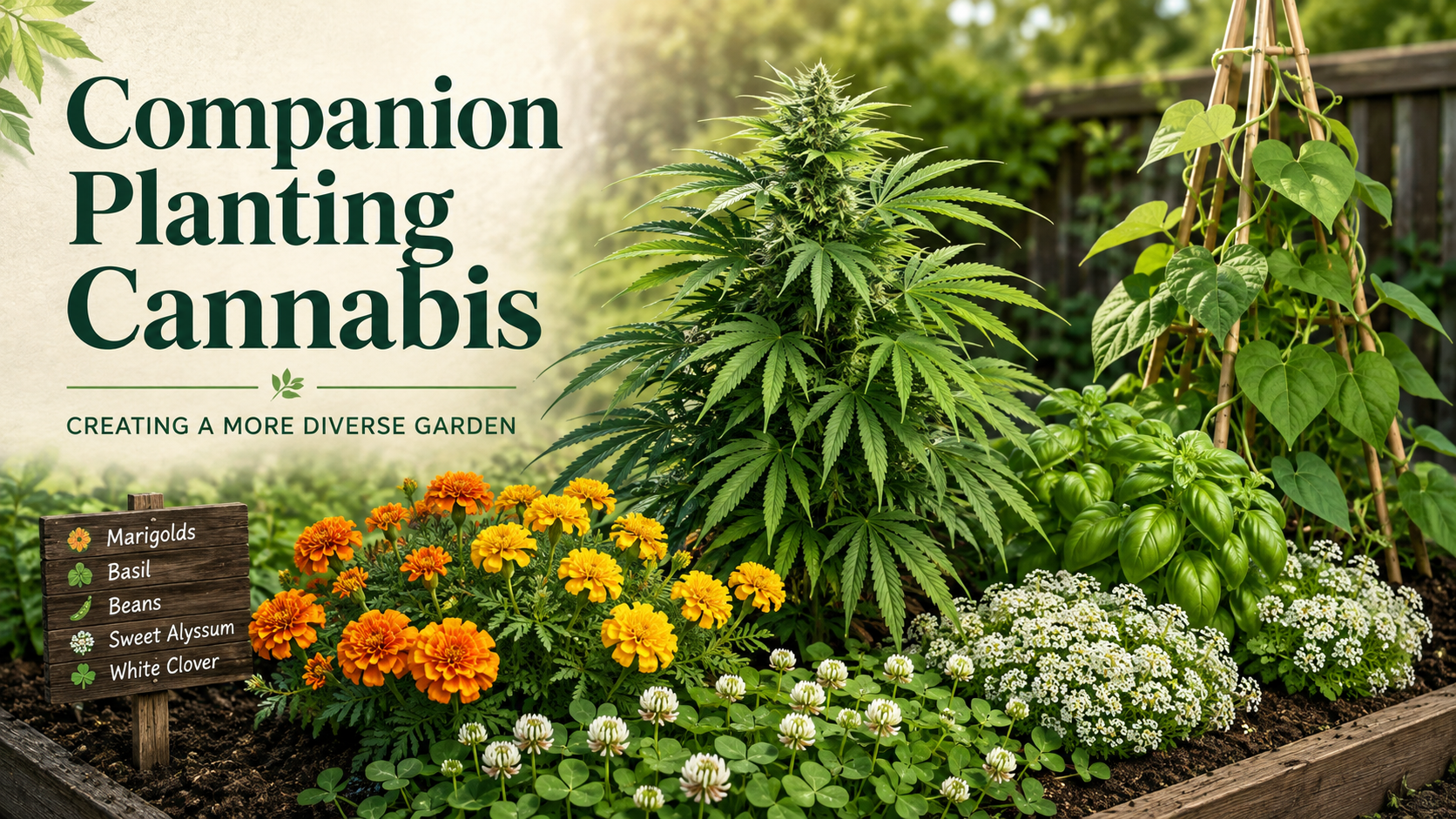
What Is Companion Planting Cannabis?
Companion planting simply means growing different plant species together because one or more can provide a useful function within the wider garden.
That could mean introducing plants that:
- Provide nectar and pollen for beneficial insects
- Act as living ground cover
- Add greater biodiversity
- Contribute to long-term soil health
- Help suppress weeds
- Support a more balanced garden ecosystem
- Provide an additional herb, flower or edible crop
The important thing is to think of companion planting as ecological garden management rather than a magic pest-control system.
The effectiveness of companion planting depends on the species involved, local conditions and what you’re trying to achieve.
That’s a much more realistic way to approach companion planting cannabis.
Why Use Companion Plants Around Cannabis?
There are several reasons companion planting has attracted so much interest among outdoor gardeners.
Encouraging Beneficial Insects
This is arguably one of the strongest reasons to increase diversity around a garden.
Not every insect you see is a pest.
Predatory and parasitoid insects can feed on unwanted garden pests, while flowering plants provide many beneficial species with nectar, pollen and shelter.
Flowers can therefore make an outdoor growing area more attractive to beneficial insects such as:
- Hoverflies
- Lacewings
- Parasitoid wasps
- Ladybirds
- Bees and other pollinators
This doesn’t mean planting one flower next to a cannabis plant guarantees protection from pests.
Instead, you’re helping create an environment capable of supporting a wider population of useful organisms.
Keeping the Soil Covered
Bare soil isn’t always desirable in a diverse garden.
Low-growing companion plants can function as a living mulch, covering exposed soil while potentially helping with weed suppression, soil stabilisation and moisture management.
White clover is a particularly interesting example because it grows close to the ground and is commonly used as a living mulch.
Again, balance is important. Companion plants are living plants themselves and will use space, water and nutrients.
Supporting Soil Fertility
Some of the most interesting companion plants belong to the legume family.
Plants such as clover and beans can form relationships with nitrogen-fixing bacteria around their roots.
These bacteria convert atmospheric nitrogen into forms that can enter the biological soil system.
It is important not to oversimplify this process. Beans and clover don’t act like instant nitrogen fertiliser for the cannabis plant growing next door.
However, they can become useful components of a longer-term soil-building system as plant material and roots are eventually recycled back into the soil.
Increasing Biodiversity
A single-species garden creates a relatively simple environment.
Adding flowers, herbs, legumes and ground-cover plants introduces different:
- Heights
- Root structures
- Flower shapes
- Flowering periods
- Scents
- Habitats
That diversity can make an outdoor garden more resilient and provide opportunities for a much wider variety of insects and soil organisms.
This is one of the more convincing arguments for companion planting cannabis, particularly within a mixed outdoor garden.
Best Companion Plants for Cannabis
There is no scientifically established list of plants guaranteed to benefit cannabis.
However, several plants commonly associated with cannabis companion planting have genuine horticultural qualities that make them useful additions to a diverse garden.
Here are some of our favourites.
1. White Clover
White clover is one of the most practical companion plants to consider from a soil perspective.
As a member of the legume family, clover forms relationships with nitrogen-fixing bacteria. These bacteria are capable of converting atmospheric nitrogen into biologically useful forms.
White clover also grows relatively low, making it suitable as living ground cover.
Why is white clover interesting?
Its potential benefits include:
- Acting as living ground cover
- Fixing atmospheric nitrogen
- Supporting pollinating insects
- Helping cover exposed soil
- Increasing biodiversity
- Contributing organic matter over time
One misconception worth clearing up is the idea that clover immediately releases nitrogen directly to neighbouring plants.
That’s an oversimplification.
Much of the nitrogen becomes part of the wider soil system gradually through natural biological processes and the decomposition of roots and foliage.
Clover is therefore better regarded as part of a long-term soil-health strategy rather than an instant fertiliser.
2. Beans
Beans are another interesting companion, particularly within a larger outdoor garden.
Like clover, beans belong to the legume family.
With the help of bacteria living in nodules around their roots, beans are capable of fixing atmospheric nitrogen.
This makes them particularly useful in gardens where maintaining biologically active, fertile soil is a priority.
You will sometimes hear that planting beans beside cannabis automatically provides the cannabis plant with extra nitrogen.
The reality is a little more complicated.
While beans are actively growing, much of the nitrogen they fix is being used by the bean plant itself. The wider benefits become more significant as roots, leaves and other organic material eventually break down and are incorporated into the soil ecosystem.
Beans are therefore best thought of as part of a longer-term soil-building system.
Potential advantages include:
- Nitrogen fixation
- Adding organic material to the soil
- Increasing plant diversity
- Providing an additional edible crop
- Contributing to longer-term soil fertility
Fava beans, in particular, are widely used as nitrogen-fixing cover crops and can be an interesting choice where space allows.
This is a good example of what companion planting is really about.
Beans won’t magically fertilise the plant next door overnight, but they can become a useful part of a healthier and more diverse garden ecosystem.
3. Sweet Alyssum
Sweet alyssum is a small flowering plant that’s become popular in biological pest-management and companion-planting systems.
Its main attraction comes from its flowers.
The numerous small blooms can provide food for beneficial insects, including species whose larvae prey on garden pests such as aphids.
That makes sweet alyssum useful as an insectary plant.
Rather than viewing it as a direct pesticide, think of sweet alyssum as a way of making the surrounding garden more welcoming to helpful insects.
It is also compact and relatively easy to incorporate around the edges of mixed planting.
4. Marigolds
Marigolds are probably one of the best-known companion plants, and they can be particularly useful in outdoor cannabis gardens where plants may be exposed to a wider variety of insects and other garden pests.
Their bright flowers increase biodiversity while providing another flowering species within the surrounding area.
Certain marigolds also have genuine pest-management benefits, which is one reason they have been planted alongside vegetables and ornamental crops for generations.
Some Tagetes marigolds have shown an ability to help suppress particular plant-parasitic nematodes, while marigolds have also been associated with reductions in certain insect pests when used in specific companion-planting combinations.
For an outdoor garden, that makes them particularly appealing.
Marigolds may help by:
- Increasing flowering diversity
- Supporting a more varied garden ecosystem
- Helping discourage or reduce certain pests in some situations
- Providing resources for beneficial insects
- Helping suppress certain soil nematodes, depending on the variety
- Creating an attractive border around an outdoor growing area
Their strong-smelling foliage is another reason they’ve traditionally been planted around vegetable gardens.
However, we wouldn’t describe marigolds as a universal natural pesticide.
Their effects are pest-specific. A marigold that helps with one problem will not necessarily prevent another.
The best way to use them is as another tool within a diverse outdoor garden rather than expecting them to form a guaranteed barrier against pests.
For companion planting cannabis outdoors, though, marigolds remain one of our favourite choices. They’re colourful, easy to incorporate into mixed planting and have more genuine horticultural value than many of the exaggerated companion-planting claims found online.
5. Basil
Basil is another classic companion plant.
The folklore surrounding basil can become exaggerated, particularly when claims are made that it directly changes the flavour of neighbouring plants.
There isn’t good evidence that planting basil beside cannabis will somehow transfer its aromatic compounds or improve cannabis terpene production.
Its usefulness lies elsewhere.
Aromatic herbs such as basil increase plant diversity and have shown useful relationships with insects in other companion-planting systems.
Basil also has the obvious advantage of being a useful culinary crop in its own right.
That’s something we particularly like about companion plants.
Instead of planting something solely because it’s supposed to benefit cannabis, you can create a garden where each species has a separate purpose.
6. Nasturtiums
Nasturtiums are another colourful option commonly found in companion gardens.
Their combination of sprawling foliage and bright flowers adds another layer of structural diversity to an outdoor space.
Research involving vegetable crops has demonstrated that nasturtiums can influence certain pest interactions, although those findings shouldn’t be interpreted as proof that they will repel every cannabis pest.
Their real value is the combination of:
- Flowering diversity
- Ground-level foliage
- Pollinator interest
- An additional edible plant
- A useful role within mixed planting
Both the flowers and leaves of nasturtiums are edible, making them another companion plant that earns its place in the garden independently of the cannabis plant.
7. Yarrow
Yarrow is frequently used in gardens designed to attract beneficial insects.
Its numerous small flowers can provide nectar and pollen for a variety of insects.
That makes it especially relevant when thinking about companion planting as habitat creation rather than simply pest repellence.
Yarrow also works well aesthetically in a more naturalistic outdoor garden and can blend easily with wildflower-style planting.
For gardeners who want to encourage biodiversity throughout an entire area rather than simply planting companions directly around one crop, yarrow can be an excellent addition.
8. Buckwheat
Another interesting option is buckwheat.
Buckwheat produces flowers capable of providing nectar and pollen to pollinating and beneficial insects.
It is frequently used within cover-cropping and insectary systems for exactly this reason.
Buckwheat grows relatively quickly and can help increase diversity within a garden while also providing organic material that can eventually return to the soil.
It’s particularly interesting for anyone wanting to move beyond the traditional idea of companion planting and towards the broader concept of an insectary garden.
Companion Plants and Beneficial Insects
One of the best ways to understand companion planting cannabis is to stop asking:
“Which plant will repel all my pests?”
and instead ask:
“How can I make the surrounding garden more attractive to useful organisms?”
That change in perspective makes a big difference.
Beneficial insects need food and habitat just like everything else.
Many adult predators and parasitoids make use of nectar and pollen, meaning flowering plants can help provide important resources.
Using several different species can be particularly useful because different plants flower at different times.
Rather than relying on one supposed “miracle” companion plant, a diverse garden could include:
- Sweet alyssum
- Marigolds
- Yarrow
- Clover
- Buckwheat
- Nasturtiums
- Other suitable flowering plants
That’s much closer to the way ecological pest management actually works.
Can Companion Plants Prevent Cannabis Pests?
They can potentially help with certain pest pressures, but this is where online advice often becomes unreliable.
Plants release volatile compounds that insects are capable of detecting.
Depending on the particular combination, neighbouring plants can sometimes:
- Repel specific pests
- Attract pests away from another plant
- Make host plants harder for insects to locate
- Attract predators of pest species
But these relationships are usually plant-specific and pest-specific.
A marigold shown to influence whiteflies around a vegetable crop shouldn’t automatically be described as a universal cannabis pest repellent.
That’s why we prefer to think of marigolds, alyssum and similar species as contributing to an overall pest-management strategy, particularly outdoors, rather than offering guaranteed protection.
Can Companion Plants Increase Nitrogen?
This is another area where some clarification helps.
Legumes such as clover and beans genuinely can fix atmospheric nitrogen.
They do this through relationships with bacteria associated with their roots.
However, this doesn’t mean the nitrogen is instantly pumped from a bean plant into a neighbouring cannabis plant.
Most of the fixed nitrogen is initially incorporated into the legume itself.
The wider soil benefit becomes more important as plant material, roots and soil organisms continually recycle nutrients through the ecosystem.
So if you are interested in companion planting cannabis primarily for nitrogen, consider:
- White clover
- Fava beans
- Other suitable beans and legumes
But view them as part of a soil-building system rather than a direct replacement for nutrient management.
Can Companion Plants Improve Cannabis Terpenes?
You’ll sometimes read that aromatic herbs such as basil, lavender or rosemary will directly increase the terpene profile or change the flavour of cannabis growing nearby.
There isn’t convincing evidence for this.
Cannabis aroma depends primarily on the plant’s own genetics and biochemical expression.
A basil plant growing next door does not simply transfer basil terpenes into cannabis flowers.
That doesn’t mean aromatic herbs are poor companion plants.
They can still:
- Increase biodiversity
- Provide flowers for insects
- Produce useful herbs
- Add another layer of scent and structure to the garden
We simply wouldn’t choose them based on promises that they will change cannabis flavour.
Potential Downsides of Companion Planting
More plants don’t automatically create a better garden.
Companion plants can create problems of their own if poorly selected or allowed to become too dense.
Potential considerations include:
- Competition for water
- Competition for nutrients
- Reduced airflow
- Excessive ground coverage
- Companion plants becoming invasive
- Providing habitat for unwanted pests
- Increased humidity in dense planting
- Different plants having incompatible requirements
Tall or vigorous companion plants can also compete for space and sunlight.
Beans are a good example.
Some climbing bean varieties can become large, so their position within a mixed garden needs to be considered carefully.
The goal isn’t to fill every available centimetre with vegetation.
It’s to create useful diversity without unnecessary competition.
Think in Terms of a Garden Ecosystem
This is probably our favourite way to approach companion planting cannabis.
Don’t look for a list of magical combinations.
Think about what each plant actually contributes.
Want living ground cover?
Consider white clover.
Interested in nitrogen-fixing plants?
Clover and beans are worth investigating.
Want more flowers and potentially useful pest-management benefits outdoors?
Marigolds are one of the obvious choices.
Want to encourage beneficial insects?
Sweet alyssum, yarrow and buckwheat can all contribute flowering resources.
Want edible companions too?
Beans, basil and nasturtiums all provide something useful independently of the cannabis plant.
That’s the key.
The strongest companion garden isn’t necessarily the one containing the largest number of species.
It’s the one where each plant has a reason for being there.
Companion Planting Cannabis: Final Thoughts
Companion planting has acquired an almost mythical reputation within parts of cannabis culture.
In reality, the science is both more complicated and more interesting.
There is sound horticultural reasoning behind using diverse planting to support beneficial insects, increase biodiversity, provide living ground cover and contribute to longer-term soil health.
Plants such as white clover, beans, sweet alyssum, marigolds, basil, nasturtiums, yarrow and buckwheat all offer characteristics that can make them useful additions to a mixed garden.
For outdoor gardens in particular, marigolds are an attractive option where pest management and flowering diversity are priorities, while beans and clover can contribute to a longer-term nitrogen-fixing and soil-building system.
The important thing is not to overstate what these plants can do.
They don’t create an invisible shield against pests, and nitrogen-fixing legumes don’t instantly fertilise neighbouring plants.
Their real value comes from the role they play within the wider ecosystem.
For us, that’s what makes companion planting cannabis so interesting.
It encourages you to look beyond one individual plant and think about what’s happening throughout the garden — among the flowers, insects, roots, microorganisms and surrounding soil.
Sometimes creating a better garden isn’t about adding another product.
It’s simply about adding a little more biodiversity by companion planting cannabis.
This article is intended for general horticultural and educational information only. Cannabis laws vary by country and region. Cannabis seeds sold by SeedMasters.com are intended as souvenirs and for genetic preservation purposes only. Customers should always comply with the laws applicable where they live.


