
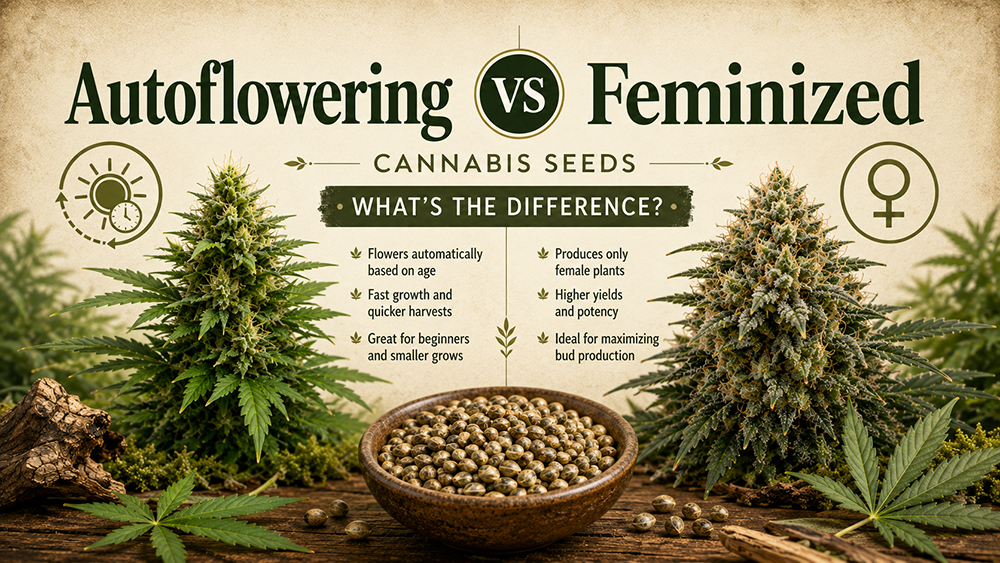
When browsing modern cannabis genetics, two terms appear almost everywhere: feminized and autoflowering.
They’re often presented as though they are two competing types of cannabis seed, which can make the difference between them unnecessarily confusing.
In reality, autoflowering vs feminized cannabis seeds isn’t quite an either/or comparison.
The two terms describe completely different characteristics.
Feminized describes the expected sex of the plants produced from the seeds.
Autoflowering describes how the plant responds to photoperiod when entering flowering.
This means a cannabis seed can actually be both feminized and autoflowering at the same time. In fact, many of the autoflowering cannabis seeds available from modern seedbanks are produced in feminized form.
Understanding that distinction makes the entire cannabis seed market considerably easier to navigate.
So let’s take a closer look at what each term actually means.
What Are Feminized Cannabis Seeds?
Feminized cannabis seeds are specially produced so that the resulting seed population is overwhelmingly genetically female.
Cannabis typically uses an XX/XY sex-chromosome system. Female cannabis plants generally carry XX chromosomes, while male plants generally carry XY chromosomes.
In conventional regular seed production, pollen from an XY male can contribute either an X or Y chromosome, meaning the resulting seeds can produce both male and female genetics.
Feminized seed production works differently.
Rather than using a conventional XY male, breeders induce a genetically female XX cannabis plant to produce functional pollen-bearing flowers.
Because that pollen comes from an XX plant, no Y chromosome is introduced through the pollen donor.
The resulting seed population can therefore be composed overwhelmingly of female XX genetics. Scientific research into cannabis feminization has demonstrated this principle using sex-reversal techniques including silver thiosulfate, commonly abbreviated to STS.
So when you see the word feminized, it primarily tells you something about the expected sex of the genetics.
It does not tell you whether those genetics are photoperiod or automatic.
What Are Autoflowering Cannabis Seeds?
Autoflowering cannabis seeds describe something completely different.
Traditional photoperiod cannabis responds strongly to the duration of light and darkness it receives. Changes in day length play an important role in initiating reproductive development.
Autoflowering cannabis is genetically photoperiod-insensitive, sometimes described as day-neutral cannabis.
Instead of requiring the same seasonal photoperiod signals as conventional cannabis, autoflowering genetics can initiate flowering independently of photoperiod. Peer-reviewed research specifically describes this photoperiod-insensitive characteristic as “autoflowering”.
This is the defining feature of an autoflower.
The term tells you about flowering behaviour.
It does not, by itself, tell you whether the seed is feminized or regular.
Autoflowering vs Feminized Cannabis Seeds: The Key Difference
The easiest way to remember the difference is:
Feminized = sex
Autoflowering = flowering behaviour
That’s really the heart of the comparison.
A feminized seed has been produced with the intention of generating female genetics.
An autoflowering seed carries genetics associated with flowering independently of conventional photoperiod triggers.
Those characteristics can exist together.
That means describing a strain simply as “feminized” doesn’t necessarily tell you how it flowers, and describing a strain simply as “autoflowering” doesn’t necessarily explain its sex format.
Can Autoflowering Cannabis Seeds Also Be Feminized?
Yes – and this is where much of the confusion comes from.
Many modern commercial autoflowering cannabis seeds are also feminized.
For example, Royal Queen Seeds explicitly describes its autoflowering seed collection as feminized while distinguishing the automatic flowering behaviour from that of feminized photoperiod varieties.
A seed can therefore be:
Autoflowering + Feminized
This means it has two separate characteristics:
Autoflowering — it carries photoperiod-insensitive flowering genetics.
Feminized — it has been produced to generate overwhelmingly female offspring.
Rather than competing categories, the two labels can describe different parts of the same seed’s genetics.
If you’re unfamiliar with regular genetics, our guide to Regular Cannabis Seeds Explained looks at how regular seeds produce male and female genetics and why they remain valuable within cannabis breeding.
Can Feminized Cannabis Seeds Be Photoperiod?
Yes.
This is actually one of the most common cannabis seed formats.
A typical modern feminized strain may be:
Feminized + Photoperiod
This means the seeds are expected to produce female genetics, but those genetics retain conventional photoperiod sensitivity.
Dutch Passion, for example, distinguishes its photoperiod feminized genetics from autoflowering varieties specifically on the basis of their response to day length.
So the useful comparison isn’t simply:
Feminized vs Autoflower
A more accurate classification looks like:
Feminized Photoperiod
versus
Feminized Autoflower
Once you look at cannabis seeds this way, the terminology becomes much clearer.
Can Autoflowering Cannabis Seeds Be Regular?
Yes.
Although feminized autoflowers dominate much of the modern retail seed market, regular autoflowering cannabis seeds can also exist.
Remember:
Regular/feminized describes sex genetics.
Autoflowering/photoperiod describes flowering behaviour.
A breeder can therefore theoretically work with:
- Regular photoperiod genetics
- Feminized photoperiod genetics
- Regular autoflowering genetics
- Feminized autoflowering genetics
Regular autoflower genetics can be particularly relevant within breeding programmes because they allow breeders to work with male and female autoflowering individuals.
This is another good example of why cannabis seed terminology is easier to understand when each label is treated separately.
What Does Photoperiod Mean?
To understand autoflowering genetics properly, it’s useful to understand the alternative.
Photoperiod refers to the relationship between an organism and the length of the light and dark periods it experiences.
Cannabis flowering time is strongly influenced by photoperiod in conventional varieties, and modern genetic studies have identified multiple genomic regions associated with flowering behaviour and photoperiod sensitivity.
Autoflowering cannabis differs because its transition to flowering is substantially less dependent on that photoperiod signal.
This is why the scientific literature often uses terms such as:
Photoperiod insensitive
or
Day neutral
when discussing autoflowering genetics.
Where Do Autoflowering Genetics Come From?
Autoflowering behaviour has historically been associated with cannabis populations adapted to northern environments where seasonal conditions can be very different from those encountered by many traditional drug-type cannabis populations.
You’ll often see autoflowering ancestry described using the term Cannabis ruderalis.
However, cannabis taxonomy is complicated, and modern scientific literature does not always treat ruderalis as a completely separate species.
For understanding modern seed genetics, the more useful concept is the actual trait itself:
photoperiod-insensitive flowering.
Modern breeders have spent generations combining that characteristic with selected photoperiod cannabis genetics.
As a result, today’s autoflowering varieties can contain genetic backgrounds associated with many familiar cannabis families while retaining automatic flowering behaviour.
Are Autoflowering Seeds Always Feminized?
No.
This is worth repeating because it is one of the most common misunderstandings.
Autoflowering does not automatically mean feminized.
Autoflower describes flowering behaviour only.
A breeder can produce autoflowering genetics as regular or feminized seeds.
However, many modern retail autoflower collections are feminized because there is substantial commercial demand for that combination. Major seedbanks commonly offer feminized autoflowering seed collections.
Therefore, when looking at a particular strain, check both:
Flowering type: Photoperiod or Autoflowering?
Seed type: Feminized or Regular?
Those two pieces of information answer different questions.
Are Feminized Seeds Always Photoperiod?
No.
This is simply the reverse of the same misconception.
A feminized seed may be:
Feminized Photoperiod
or:
Feminized Autoflowering
Feminization doesn’t alter the basic definition of the flowering mechanism.
It only describes how the sex genetics of the seed population have been managed.
Autoflowering vs Feminized Cannabis Seeds at a Glance
| Characteristic | Autoflowering | Feminized |
|---|---|---|
| Describes plant sex? | No | Yes |
| Describes flowering behaviour? | Yes | No |
| Can produce female genetics? | Yes | Yes |
| Can be feminized? | Yes | Already feminized |
| Can be regular? | Yes | No |
| Can be photoperiod? | No | Yes |
| Can be combined with the other category? | Yes | Yes |
| Main defining trait | Photoperiod-insensitive flowering | Overwhelmingly female genetics |
The simplest rule remains:
Autoflower = flowering behaviour
Feminized = sex genetics
What Are Feminized Photoperiod Cannabis Seeds?
Feminized photoperiod cannabis seeds combine female-focused seed production with traditional photoperiod-sensitive cannabis genetics.
This is what many people simply mean when they use the phrase “feminized seeds”.
However, technically, feminized alone doesn’t tell us that the strain is photoperiod.
The complete description is feminized photoperiod.
These varieties retain the photoperiod-sensitive flowering characteristics typical of conventional cannabis while being produced in an overwhelmingly female seed format.
That distinguishes them from feminized autoflowering strains.
What Are Feminized Autoflowering Cannabis Seeds?
Feminized autoflowering cannabis seeds combine both traits.
They have been bred to:
1. Carry autoflowering genetics
and
2. Produce overwhelmingly female offspring
This combination has become an enormous part of the modern cannabis seed industry.
Established breeders including Dutch Passion and Royal Queen Seeds maintain large autoflowering collections alongside their photoperiod feminized genetics.
From a genetics perspective, this demonstrates how different breeding characteristics can be stacked together within the same strain.
Feminized vs Regular Is a Different Comparison
Another way to understand this topic is to pair each term with its true opposite.
The meaningful comparison for feminized is:
because those terms describe sex genetics.
The meaningful comparison for autoflowering is:
Autoflowering vs Photoperiod
because those terms describe flowering behaviour.
So:
Feminized ↔ Regular
Autoflowering ↔ Photoperiod
This simple distinction clears up most of the confusion.
We explore the first comparison in much greater detail in our guide to Feminized vs Regular Cannabis Seeds: What’s the Difference?
Autoflowering vs Photoperiod Is the More Accurate Genetic Comparison
When researchers investigate automatic flowering in cannabis, they generally compare photoperiod-sensitive and photoperiod-insensitive flowering behaviour, rather than comparing automatic genetics with feminized seeds.
Research has identified genetic regions associated with the photoperiod-insensitive phenotype and continues to investigate the molecular basis of flowering-time control in Cannabis sativa.
That’s because feminization is answering a completely different genetic question.
It is possible to have a photoperiod female and an autoflowering female.
The difference between those plants isn’t their sex.
It’s their flowering behaviour.
Does Autoflowering Mean Faster?
Autoflowering genetics are frequently associated with relatively rapid overall developmental cycles, and commercial breeders commonly market them on this basis.
But autoflowering technically means photoperiod-insensitive flowering, not simply “fast cannabis”.
Those are related concepts, but they aren’t identical.
Some photoperiod varieties have also been specifically selected for shorter flowering periods.
This has created categories such as:
Fast Flowering
Fast Version
Early Version
These strains remain photoperiod-dependent even though they may have shorter flowering periods than many traditional photoperiod varieties.
That’s why we explore this separately in our guide to Fast Flowering vs Autoflowering Cannabis Seeds.
The important takeaway is:
Fast doesn’t necessarily mean automatic.
Are Autoflowering Seeds a Type of Feminized Seed?
They can be, but not inherently.
Think of cannabis genetics as having several different labels stacked together.
A seed listing could theoretically tell you:
Sex type
Feminized
Flowering type
Autoflowering
Generation
F1
Broad breeder classification
Hybrid
All four labels could describe the same seed.
None replaces the others.
This is one reason modern cannabis genetics can initially appear complicated. Breeders are describing several different biological characteristics simultaneously.
Once those characteristics are separated, the terminology becomes considerably easier to understand.
Can F1 Cannabis Seeds Be Autoflowering or Feminized?
Yes.
F1 is yet another separate category.
F1 means first filial generation, describing a generation within a breeding programme.
It doesn’t inherently tell you:
- Whether the seeds are regular or feminized
- Whether they’re photoperiod or automatic
- Whether they’re indica, sativa or hybrid
A breeder can therefore potentially produce genetics described as:
F1 Feminized Photoperiod
or:
F1 Feminized Autoflowering
This is why our guide to What Are F1 Cannabis Seeds? treats F1 as a breeding-generation term rather than a flowering or sex category.
Are Autoflowering Genetics Less Advanced Than Photoperiod Genetics?
Not inherently.
Early commercial autoflowering cannabis was considerably more limited than today’s genetics, which helped create a reputation that autos were somehow simpler or less sophisticated.
Modern autoflower breeding has moved far beyond those early generations.
Breeders have repeatedly crossed, selected and refined automatic lines using genetics from established cannabis families.
The defining characteristic remains photoperiod insensitivity, not a particular potency, terpene profile, plant shape or quality level.
The quality of an autoflowering strain ultimately depends on the breeder, parental genetics, selection programme and stability of the line — just as it does with photoperiod genetics.
Does Feminized Mean Better Quality?
No.
The same principle applies to feminized cannabis seeds.
Feminized is not a quality grade.
It describes the intended sex composition of the seed population.
Excellent and poor-quality genetics can both be feminized.
Likewise, excellent and poor-quality genetics can both be regular.
When evaluating a cannabis strain, factors such as breeder reputation, genetic lineage, parental selection and breeding history tell you considerably more about quality than the feminized label alone.
Does Autoflowering Mean Better Quality?
Again, no.
Autoflowering simply describes flowering behaviour.
The automatic trait doesn’t inherently make the surrounding genetics better or worse.
Modern cannabis breeding increasingly involves combining multiple desirable characteristics within a single genetic line.
The result is an increasingly diverse autoflower market containing genetics associated with everything from traditional Kush and Haze families to modern fruit, dessert and American hybrid varieties.
The important thing is to look at the actual breeding programme behind the strain.
Autoflowering vs Feminized Cannabis Seeds: Which Should You Choose?
From a collecting perspective, the answer depends on what aspect of cannabis genetics interests you.
If you’re specifically interested in the sex format, compare:
Feminized vs Regular cannabis seeds
If you’re interested in flowering genetics, compare:
Autoflowering vs Photoperiod cannabis seeds
And if you’re looking at a modern autoflower, remember that it may already be feminized.
In other words, asking whether a seed should be “autoflowering or feminized” can be a little like asking whether a car should be “automatic or blue”.
The characteristics aren’t mutually exclusive.
A seed can be both.
Common Myths About Autoflowering vs Feminized Cannabis Seeds
“Autoflowering and feminized are opposite seed types”
No.
Autoflowering describes flowering behaviour, while feminized describes sex genetics.
“All autoflowers are feminized”
No.
Regular autoflowering genetics can exist, even though feminized autos are extremely common commercially.
“All feminized seeds are photoperiod”
No.
Feminized autoflowering seeds are widely available.
“Feminized means the plant flowers automatically”
No.
Feminized photoperiod strains still retain photoperiod-sensitive flowering behaviour.
“Autoflower means feminization isn’t needed”
No.
Flowering behaviour and sex genetics are independent characteristics.
“Autoflowering just means fast flowering”
Not quite.
Autoflowering specifically refers to photoperiod-insensitive flowering. Some photoperiod strains are also bred to flower quickly.
Understanding Modern Cannabis Seed Labels
The easiest way to understand modern cannabis seeds is to ask several separate questions.
What is the sex format?
Regular or Feminized?
What is the flowering type?
Photoperiod or Autoflowering?
What generation is it?
Possibly F1, F2, S1, BX or another breeder designation.
What genetic background does it have?
This could include terminology such as Indica, Sativa, Hybrid, landrace-derived or IBL.
Each label tells you something different.
This is exactly why we have been expanding the SeedMasters genetics guides: once you understand what each term actually describes, cannabis seed catalogues become much easier to interpret.
Autoflowering vs Feminized Cannabis Seeds: Final Thoughts
When comparing autoflowering vs feminized cannabis seeds, the most important thing to remember is that they are not opposing categories.
They describe two completely different aspects of cannabis genetics.
Feminized cannabis seeds are produced so that the resulting seed population is overwhelmingly genetically female.
Autoflowering cannabis seeds contain genetics associated with flowering independently of conventional photoperiod triggers. Scientific research commonly refers to this characteristic as photoperiod insensitivity or day-neutral flowering.
A cannabis seed can consequently be:
Feminized + Photoperiod
Feminized + Autoflowering
Regular + Photoperiod
or:
Regular + Autoflowering
For most modern collectors, the biggest source of confusion comes from the fact that many commercial automatic seeds are also feminized.
So the simplest way to remember everything is:
Feminized = sex genetics
Autoflowering = flowering behaviour
Understanding that distinction provides a foundation for making sense of many other cannabis breeding terms, including regular seeds, Fast Flowering genetics, F1 hybrids, S1 seeds and photoperiod strains.
At SeedMasters.com, we think understanding the genetics behind a strain is just as interesting as the strain name itself. Our collection brings together feminized, autoflowering, regular and specialist cannabis seeds from established and emerging breeders around the world, giving collectors access to an enormous range of modern and traditional genetics.
All cannabis seeds sold by SeedMasters.com are intended strictly as souvenirs and for genetic preservation purposes only. Please check and comply with the laws applicable in your country before ordering.


