
For much of cannabis breeding history, regular cannabis seeds were simply cannabis seeds. Before feminized varieties became widely available, a traditional seed population naturally contained the potential for both male and female plants.
Today, regular seeds sit alongside feminized, autoflowering, Fast Flowering, F1 and other specialist genetics, which can make them seem almost like a niche category.
In reality, they remain enormously important.
Regular cannabis seeds preserve access to both male and female genetics, making them particularly valuable to breeders, collectors and anyone interested in the wider genetic history of cannabis.
But what exactly makes a seed “regular”? Do regular seeds always produce a 50/50 split of males and females? Are they more genetically diverse than feminized seeds? And why do established breeders continue producing them when feminized cannabis seeds have become so popular?
In this guide, we’re taking a closer look at regular cannabis seeds, how they are created and the role they continue to play in modern cannabis genetics.
What Are Regular Cannabis Seeds?
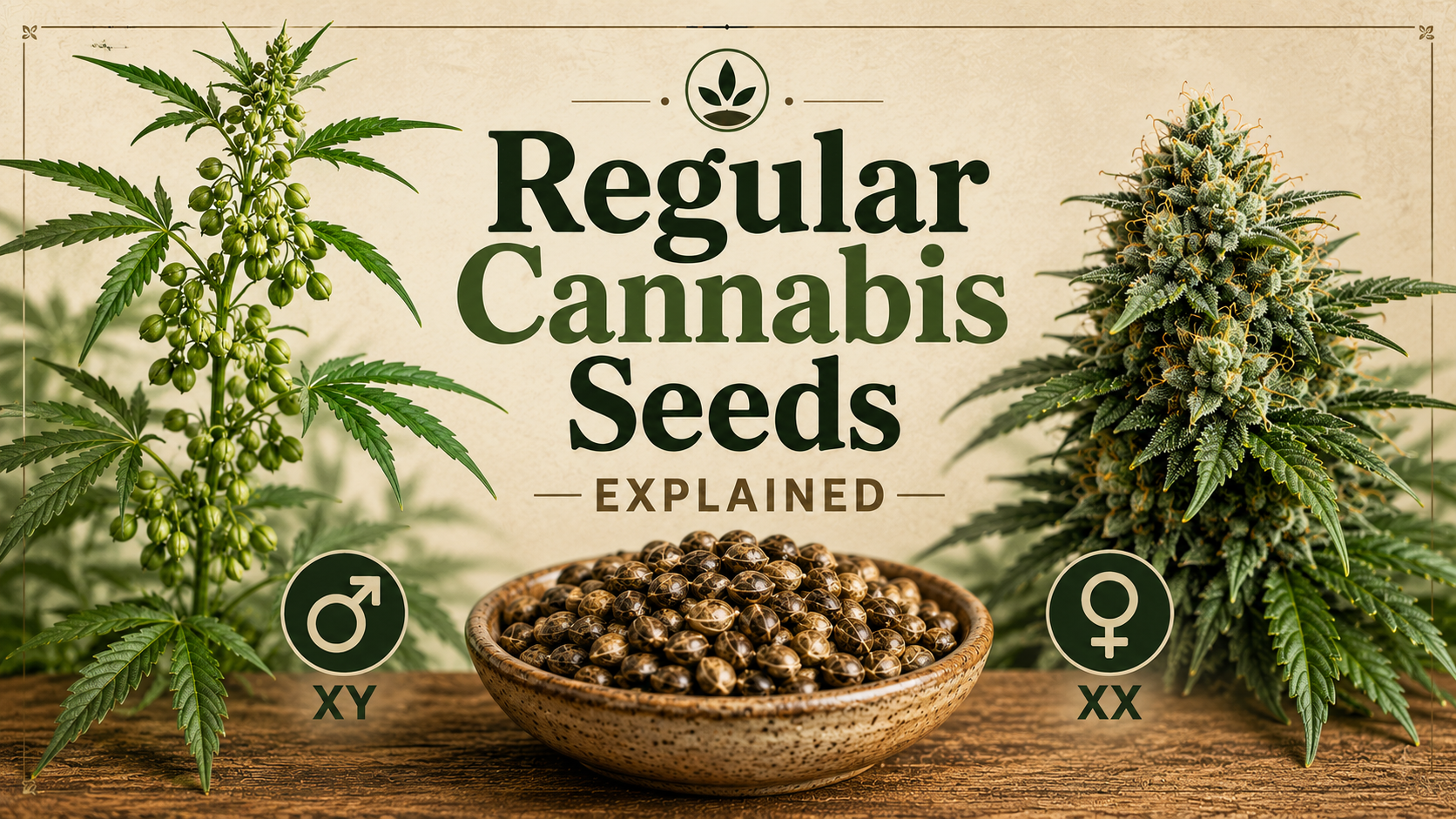
Regular cannabis seeds are seeds produced through conventional sexual reproduction, usually involving pollen from a genetically male cannabis plant fertilising a genetically female plant.
Cannabis is predominantly dioecious, meaning male and female reproductive structures normally occur on separate plants. In typical dioecious cannabis, females carry XX sex chromosomes while males carry XY chromosomes.
A conventional regular cross can therefore be simplified as:
Female XX × Male XY
The female parent contributes an X chromosome, while pollen from the male can contribute either an X or Y.
The resulting offspring can consequently be:
XX = genetically female
or
XY = genetically male
That ability to produce both sexes is the defining characteristic of regular cannabis seed.
Do Regular Cannabis Seeds Produce 50% Male and 50% Female Plants?
You will often hear regular cannabis seeds described as producing roughly 50% males and 50% females.
At a population level, that’s a useful expectation.
Research examining conventionally cross-pollinated cannabis has observed approximately a 1:1 male-to-female ratio, which is consistent with the plant’s XX/XY sex-chromosome system.
However, that doesn’t mean every individual packet of ten regular seeds must contain exactly five males and five females.
Probability doesn’t work that neatly in small samples.
One packet could contain more females, another more males, and another might happen to contain an even split.
So we’d describe regular cannabis seeds as having an approximately equal probability of male and female genetics across a sufficiently large population, rather than promising an exact 50/50 result in every seed pack.
Why Does Cannabis Produce Male and Female Plants?
Separate male and female plants are part of the natural reproductive biology of dioecious cannabis.
The male plant produces pollen.
The female plant produces ovules contained within female flowers.
When pollen reaches a receptive female flower, fertilisation allows the next generation of seeds to form.
This also means cannabis is naturally capable of outcrossing, where genetic material from separate individuals is combined in the next generation. Research into cannabis genetics describes its dioecious, outcrossing behaviour as one contributor to the considerable variability found throughout the species.
For breeders, that reproductive system provides enormous possibilities.
A selected male can be crossed with a selected female, combining genetic material from both into a new generation.
That basic process has formed the foundation of cannabis breeding for generations.
Why Are Male Cannabis Genetics Important?
When people first encounter regular seeds, it’s easy to think of the male plants as simply the unwanted half of the packet.
From a breeder’s perspective, that’s completely the wrong way to look at them.
A male contributes approximately half of the nuclear genetic material inherited by its offspring.
This means breeders can select males from promising families and evaluate the characteristics they pass into subsequent generations.
A breeder might be interested in a male because of its:
- Genetic lineage
- Structure
- Vigour
- Flowering characteristics
- Aroma
- Family traits
- Pollen production
- Performance of related offspring
- Ability to complement a particular female line
Importantly, breeders aren’t selecting males simply because they are male.
Good breeding still comes down to selection.
The breeder needs to identify individuals carrying or transmitting the characteristics needed for a particular project.
Regular cannabis seeds provide access to those male genetics in a way that standard feminized seed populations generally do not.
Why Do Cannabis Breeders Still Use Regular Seeds?
Modern feminization techniques have made it possible to create new varieties without using a conventional XY male.
So why continue working with regular seeds?
One of the biggest reasons is that traditional male × female breeding remains extremely useful.
Regular populations allow breeders to work with both sides of a genetic family and explore combinations between selected males and females.
Cannabis itself possesses considerable genetic diversity, and conventional crossing and selection remain important tools for developing new lines and incorporating useful traits into breeding programmes.
Regular seeds can therefore be particularly valuable for:
- Creating new crosses
- Maintaining male genetic lines
- Exploring genetic variation
- Developing breeding populations
- Preserving older genetics
- Selecting future parent plants
- Continuing multi-generation breeding projects
This is why some specialist breeders continue to offer a substantial percentage of their collections as regular seeds even though the wider retail market is now dominated by feminized varieties.
Regular Cannabis Seeds vs Feminized Cannabis Seeds
The easiest way to understand regular cannabis seeds is to compare them with feminized seeds.
Regular Seeds
Usually produced using:
Female XX × Male XY
The resulting population can contain:
XX females + XY males
Feminized Seeds
Feminized seed production uses pollen originating from a genetically female XX plant rather than a conventional XY male.
Because the pollen source doesn’t contribute a Y chromosome, the resulting seeds are expected to be overwhelmingly XX.
Scientific studies have demonstrated the production of feminized cannabis seed through this type of female-derived pollen system.
So the main distinction isn’t quality.
It’s sex genetics and breeding method.
We look at this in much greater detail in our separate guide, Feminized vs Regular Cannabis Seeds: What’s the Difference?
Are Regular Cannabis Seeds Better Than Feminized Seeds?
Not automatically.
This is probably the biggest misconception surrounding the two categories.
Regular and feminized describe how the seeds were produced and the expected sex composition of their offspring.
Neither term tells you whether the genetics are good.
An exceptional breeder can create excellent regular or feminized genetics.
Likewise, poor parental selection can produce disappointing genetics regardless of which seed format is used.
Quality depends on factors such as:
- Parental genetics
- Selection
- Breeding history
- Population size
- Testing
- Stability
- Breeder experience
- The objectives of the breeding programme
Regular seed shouldn’t be regarded as a quality grade.
Neither should feminized seed.
They are simply different genetic formats.
Are Regular Cannabis Seeds More Genetically Diverse?
This question needs a little nuance.
Regular seeds are sometimes described as automatically being more genetically diverse than feminized seeds.
That isn’t necessarily true.
Cannabis as a species contains extensive genetic diversity, and studies of different cannabis populations demonstrate substantial variation and population structure.
But the amount of diversity within a particular seed line depends on its breeding history, not simply whether the seeds are regular or feminized.
A highly inbred regular line could be relatively uniform.
A feminized cross between genetically different parents could display substantial variation.
What regular seeds do uniquely provide is access to both XX and XY offspring, including male-associated genetic material and the Y chromosome.
That’s different from saying every regular seed population is automatically more genetically diverse.
At SeedMasters.com, we’d rather make that distinction than repeat the common claim that “regular always means more genetic variation”.
Are Regular Cannabis Seeds More Stable?
Again, not automatically.
Genetic stability and regular seed production are separate concepts.
A strain becomes more uniform through its breeding history and the way particular characteristics have been selected and fixed over generations.
A regular variety could be:
- An early-generation hybrid with considerable variation
- An established breeding line
- An inbred line
- A landrace-derived population
- A backcross
- A regular F1 hybrid
- A multi-generation stabilised strain
The word regular doesn’t tell you which of those it is.
This is why understanding cannabis terminology such as F1, F2, BX, IBL and S1 can be so useful.
Each term tells you something different about how a particular genetic line was produced.
Are Regular Cannabis Seeds More Genetically Stable?
There’s a common belief that regular cannabis seeds are naturally more genetically stable than feminized seeds, but that’s not necessarily true.
Regular seeds can preserve a broad range of genetic characteristics, making them particularly interesting to breeders and collectors. However, genetic stability depends more on the breeding work behind a strain than whether its seeds are regular or feminized.
A carefully developed genetic line may display consistent characteristics across generations, while a less refined line can produce considerable variation.
This is where inbred lines (IBLs) become important. Through generations of selective breeding, breeders can establish lines with more predictable inherited traits. These lines can also play an important role in the development of uniform F1 hybrids.
We’ve covered this in more detail in our guide to IBL cannabis strains, including how breeders work towards genetic consistency.
Ultimately, regular seeds aren’t automatically more stable. The quality of the breeding programme and the genetic background are what really matter.
Regular Seeds vs F1 Seeds
Another common misunderstanding is that regular and F1 describe competing seed categories.
They don’t.
Regular describes the expected male-and-female nature of the seed population.
F1 describes a generation within a cross.
An F1 hybrid can therefore be regular.
For example:
Selected Female Parent × Selected Male Parent = Regular F1 offspring
Depending on the breeding system being used, breeders can also produce feminized F1 genetics.
This means a strain may be:
Regular + F1
or:
Feminized + F1
The labels describe different aspects of the genetics.
Our guide to What Are F1 Cannabis Seeds? explores this in much greater detail.
Can Autoflowering Seeds Be Regular?
Yes.
This is another useful example of overlapping cannabis terminology.
Autoflowering describes flowering behaviour.
Regular describes sex genetics.
They aren’t opposites.
A breeder can therefore produce:
Regular Photoperiod Seeds
Feminized Photoperiod Seeds
Regular Autoflowering Seeds
Feminized Autoflowering Seeds
Regular autoflower seeds are less common in mainstream retail collections today, but they remain useful within breeding programmes because they can provide male autoflowering genetics.
Regular Doesn’t Mean Photoperiod
Because most regular varieties encountered historically were photoperiod strains, it’s easy to associate the two terms.
But regular doesn’t inherently mean photoperiod.
Likewise, feminized doesn’t inherently mean photoperiod.
A seed listing needs to be read as a collection of different characteristics.
For example:
Regular tells you about the expected sex population.
Autoflowering tells you about flowering behaviour.
F1 tells you about breeding generation.
Indica, Sativa or Hybrid may describe aspects of ancestry or breeder classification.
Understanding these terms individually makes modern cannabis genetics much easier to navigate.
Can You Tell Whether a Cannabis Seed Is Male or Female by Looking at It?
No reliable visual method exists for determining the genetic sex of an ordinary cannabis seed just by examining its shape, colour, size or surface markings.
You’ll occasionally encounter claims that female seeds have a particular shape or that male seeds can be identified by markings on the shell, but these aren’t reliable genetic tests.
The fact that researchers have developed DNA-marker and PCR-based approaches specifically to identify cannabis sex illustrates that sex determination depends on genetics rather than an obvious external feature of the seed shell.
In other words, a brown striped seed can’t simply be looked at and classified as XX or XY.
This is one of those pieces of cannabis folklore that is best left behind.
What About Hermaphroditic or Monoecious Cannabis?
Male and female isn’t quite the entire story.
Cannabis is predominantly dioecious, but the species also exhibits considerable sexual plasticity.
Researchers have documented plants capable of producing both male and female reproductive structures, and modern studies continue to investigate the complex relationship between sex chromosomes, hormones, genetics and environmental influences on cannabis sex expression.
This means an XX genetic background doesn’t always guarantee that a plant will express exclusively female flowers throughout its life.
Likewise, recent research has further demonstrated that cannabis sex expression can be more biologically complex than a simple XX-female/XY-male diagram might suggest.
For understanding ordinary regular seeds, though, XX female and XY male remains the useful basic model.
Are Regular Seeds the Same as Landrace Seeds?
No.
This is another distinction worth making.
Regular refers to the seed’s sex genetics.
Landrace refers to a geographically and historically distinct cannabis population associated with long-term adaptation to a particular region.
A landrace accession may be sold as regular seed because traditional populations commonly contain males and females.
But not every regular strain is a landrace.
In fact, many regular cannabis seeds are highly modern hybrids created from genetics originating from several different regions or breeding programmes.
A seed can therefore be:
Regular + Landrace
or:
Regular + Modern Hybrid
Again, these labels answer different questions.
Why Regular Seeds Matter for Genetic Preservation
Regular seeds can have particular value when the objective is to preserve a broader breeding population rather than only female expressions.
Because conventional regular populations contain the potential for both XY and XX offspring, breeders can maintain access to male genetics as well as females.
This can be particularly important for:
- Old breeding lines
- Landrace-derived populations
- Rare genetics
- Specialist breeding projects
- Preservation populations
- Traditional male × female selection
Genetic resources and diverse cannabis germplasm are valuable because they provide material from which breeders can identify and select characteristics for future breeding. Research into cannabis germplasm consistently highlights genetic diversity as an important resource for breeding and preservation.
For seed collectors interested in the history and development of cannabis, this makes regular genetics especially fascinating.
Why Have Feminized Seeds Become More Common?
If regular seeds are so important, why are so many modern seed catalogues dominated by feminized genetics?
The answer is largely convenience and market demand.
Feminized breeding allows seed companies to reproduce and distribute selected female genetics without introducing conventional male offspring into the seed population.
As feminization techniques became increasingly effective, breeders gained another powerful method for preserving, combining and distributing desirable female genetics. Scientific work has refined feminized seed-production techniques considerably and demonstrated high rates of female offspring using controlled sex-reversal systems.
That doesn’t make regular genetics obsolete.
Instead, the modern cannabis seed industry now has two complementary breeding approaches.
Regular genetics continue traditional male × female breeding.
Feminized genetics allow breeders to work specifically with selected female lines.
Both have an important place.
Do Major Cannabis Breeders Still Produce Regular Seeds?
Yes.
Although feminized cannabis seeds make up a large part of today’s commercial market, regular genetics remain particularly common among specialist breeding companies and breeders focused heavily on developing new genetic lines.
This is partly because regular populations allow breeders to select both males and females when creating subsequent generations.
Some breeding programmes begin with regular genetics before particular selections are later developed into feminized versions.
Others remain regular throughout because retaining male genetics is a deliberate part of the breeder’s objectives.
The existence of feminized seeds hasn’t removed the usefulness of conventional cannabis breeding.
It has simply given breeders another option.
Who Are Regular Cannabis Seeds Most Interesting For?
From a genetics and collecting perspective, regular seeds are particularly interesting for people interested in:
- Cannabis breeding history
- Male and female genetics
- Rare or older varieties
- Genetic preservation
- Landrace-derived populations
- Traditional breeding programmes
- Specialist breeder releases
- Studying how cannabis traits move through generations
For someone simply comparing modern commercial strain names, the difference might initially seem minor.
For anyone fascinated by how cannabis genetics are actually created, regular seeds become considerably more interesting.
They represent access not just to a female expression of a strain, but to the male side of the genetic population as well.
Common Myths About Regular Cannabis Seeds
Several misconceptions are worth clearing up.
“Regular seeds are always 50% male and 50% female”
Across large populations, approximately 1:1 is a sensible expectation.
A small seed packet doesn’t have to produce an exact numerical split.
“Regular seeds are always more stable”
No.
Stability depends on the breeding programme, not whether the seeds are regular.
“Regular seeds are always more genetically diverse”
Not necessarily.
Genetic diversity depends on ancestry and breeding history. Regular seeds uniquely preserve access to both male and female offspring, but that isn’t the same as automatically having greater diversity.
“Regular means photoperiod”
No.
Regular autoflowering seeds also exist.
“Regular seeds are always landraces”
No.
Regular seeds can represent anything from traditional regional populations to extremely modern hybrids.
“You can identify male seeds by looking at them”
No reliable evidence supports identifying cannabis sex from the external appearance of the seed. Genetic sex-testing techniques instead rely on molecular markers.
Regular Cannabis Seeds Explained: Final Thoughts
At their simplest, regular cannabis seeds are seeds capable of producing both male and female cannabis genetics.
They are generally created through conventional reproduction between:
XX female × XY male
This produces offspring with the potential to inherit either:
XX female genetics
or:
XY male genetics
Across large populations, those sexes tend towards an approximately equal ratio, although individual seed packs can naturally vary.
What makes regular seeds particularly important isn’t simply the presence of males.
It’s what those males represent.
They provide breeders with access to the other half of traditional cannabis reproduction, allowing selected male genetics to be combined with selected females to create new generations.
Regular seeds don’t automatically mean better genetics, greater stability or greater diversity.
Those characteristics depend on the breeding programme behind the strain.
What regular cannabis seeds do provide is a traditional male-and-female genetic population — something that remains extremely valuable for breeding, collecting and genetic preservation.
At SeedMasters.com, we think understanding those distinctions is an important part of appreciating cannabis genetics. Modern seed collections now include feminized, regular, autoflowering, Fast Flowering, F1 and other specialist formats, but each exists for a different reason.
Regular seeds may be one of the oldest formats in the cannabis seed world, but from a breeding perspective, they remain as relevant as ever.
All cannabis seeds sold by SeedMasters.com are intended strictly as souvenirs and for genetic preservation purposes only. Please check and comply with the laws applicable in your country before ordering.


