
Triploid cannabis seeds are the talk of the grow scene right now. They promise bigger harvests, stronger buds, and flower that stays seedless even when pollen turns up uninvited. But what does “triploid” actually mean? And are these strains worth your time?
Let’s break it down. This guide covers what triploid cannabis is, how the seeds are made, how they stack up against the feminized and autoflower seeds you already know, and what to expect if you grow them. Beginner or seasoned grower, you’ll both find your footing here.
What are triploid cannabis seeds?
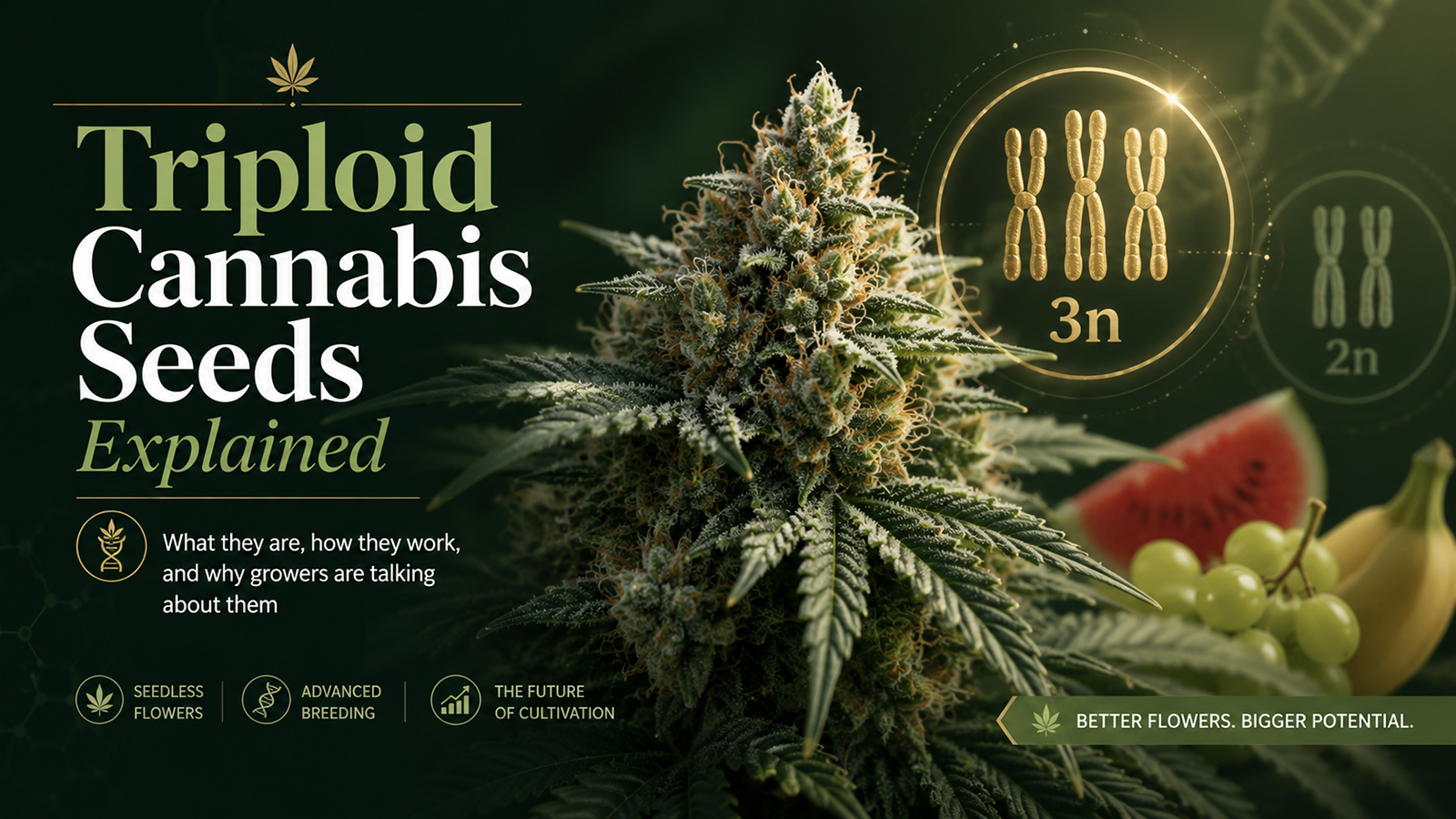
Most cannabis is diploid. That means every cell carries two sets of chromosomes, commonly written as 2n whereas triploid plants carry three sets (3n). One extra set sounds small, but it changes how the plant grows, flowers, and reproduces.
Here’s the big one: triploids are basically sterile. With an odd number of chromosome sets, the plant can’t easily make viable seeds or pollen. So the buds stay seedless, even in a garden where a normal plant would end up rattling with seeds. Breeders like to call triploids the “mules of the cannabis world” – productive, but a genetic dead end that doesn’t pass its traits on.
You’ve eaten a triploid before, by the way. Seedless watermelon, bananas, seedless grapes – all triploid. Roughly a third of the world’s commercial crops lean on this chromosome trick, and farmers have used it since the early 1900s. Cannabis is just the newest crop to get the treatment.
How are triploid seeds made?
No lab-made DNA is involved here. Triploid seeds come from natural plant breeding, and the process runs in two steps.
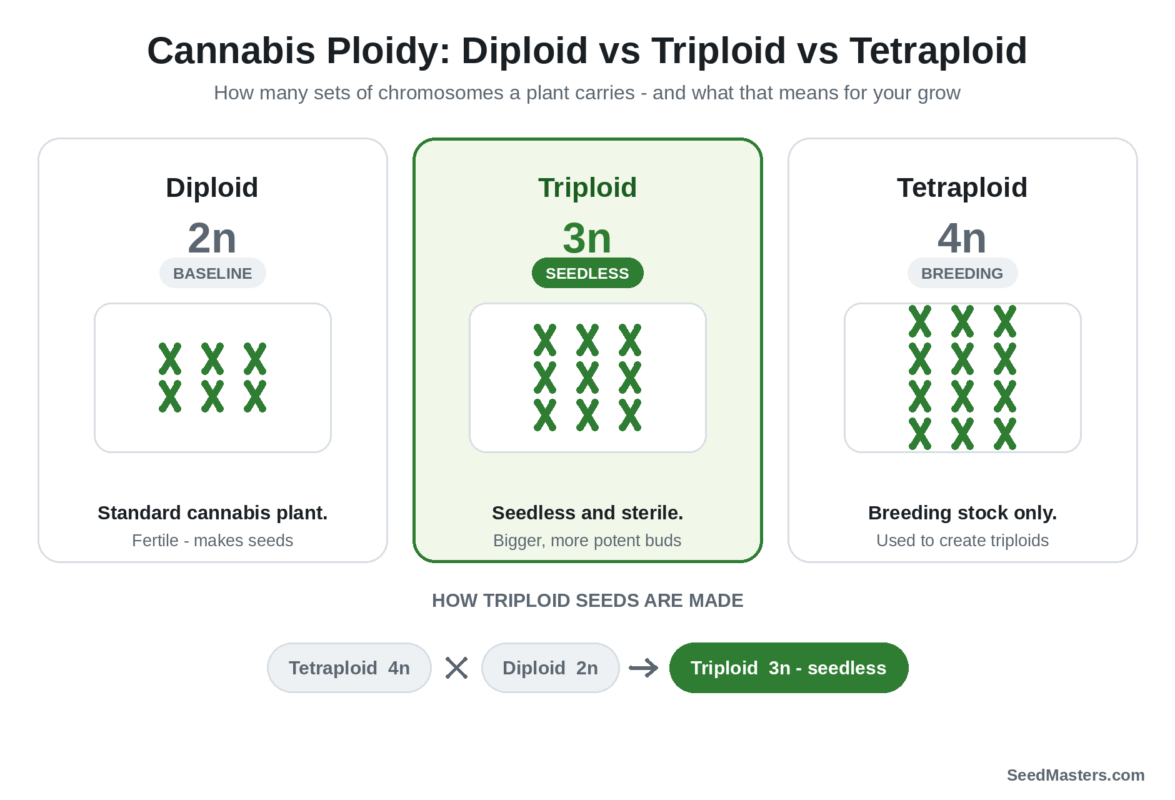
First, a breeder makes a tetraploid plant – that’s four sets of chromosomes (4n). They do it by treating a normal plant with a natural compound like colchicine, which briefly pauses cell division so the chromosomes double up without the cell splitting. The result is a stable tetraploid mother.
Next, they cross that tetraploid (4n) with a standard diploid (2n). The offspring land in the middle, with three sets of chromosomes: a triploid (3n). Those are the seeds you buy, and they grow into the seedless plants everyone’s after.
Because nothing foreign is ever added, triploid cannabis isn’t a GMO. More on that below.
Triploid vs diploid vs tetraploid: what’s the difference?
It’s easy to get lost in the numbers, so here’s the short version. A diploid (2n) is your standard cannabis plant – two chromosome sets, fully fertile, the baseline for nearly every strain out there. A triploid (3n) has three sets, which makes it seedless and, by most reports, more productive. A tetraploid (4n) has four sets and mostly gets used as breeding stock to make triploids, rather than grown for flower.
All of these sit under one umbrella term: polyploid cannabis. So when you see breeders throwing around “polyploid”, “triploid”, and “tetraploid” in the same breath, that’s what they mean.
What are the benefits of triploid strains?
Triploid genetics are still new, so treat the numbers below as early breeder results rather than gospel. Even so, the reported gains are hard to ignore.
Seedless buds, guaranteed. That’s the headline. Triploids barely react to pollen, so you get clean, seedless flower even in an open or mixed garden. One of the biggest headaches in outdoor and greenhouse growing just vanishes.
Bigger yields come next. Humboldt Seed Company, the breeder that kicked off commercial triploids, reports flower-yield jumps of roughly 10-20% over comparable diploid plants.
Then there’s the punch. With no seeds to feed, the plant pours its energy into flower instead. Reported THC gains sit around 3-5%, alongside frostier trichomes and richer terpenes. More flavour, stronger hit.
Extract makers do well here too. Triploids have shown fresh-frozen live rosin gains of about 10-15%, which is a big deal for hash and rosin heads.
Crops also finish faster and tidier. Many triploid strains wrap up flowering 5-10 days sooner and grow more evenly from plant to plant. Run a commercial room and that predictability is gold. One last perk: since triploids don’t throw viable pollen, you can sit them next to other strains without wrecking anyone’s harvest.
Are there any downsides to triploid cannabis seeds?
No seed type is perfect, and triploids come with a few catches worth knowing. They’re new, for a start. Next to feminized and autoflower seeds, the triploid catalogue is small and the long-term data is thin. You can’t breed from them, either – the sterility that keeps buds seedless also means you can’t make your own line, so you’ll head back to the seed bank each time (though they clone just fine). Price and choice are the other sticking points, since a premium, cutting-edge product tends to cost more and come in fewer varieties. And “seedless” isn’t a cast-iron 100%. Most breeders say 99%, so the odd seed can still slip through.
Triploid vs feminized seeds: which should you grow?
This is the question most growers really want answered, so let’s be clear. Triploid and feminized aren’t rivals. Plenty of triploid strains are feminized too.
Feminized seeds fix one thing: sex. They give you female, flower-bearing plants almost every time, so you’re not hunting down and binning males. Triploid seeds fix a different thing: seeds. They keep your flower seedless and push more energy into potent bud. Want to avoid males? Feminized does the job. Want seedless insurance plus a shot at bigger, stronger harvests? That’s the triploid upgrade – and you can often get both traits in a single strain.
Are triploid cannabis seeds GMO?
No. This myth needs busting, so here’s the plain answer. A GMO has foreign DNA slotted in from another organism. Triploids have none of that. They simply carry an extra copy of the plant’s own chromosomes, made through the same natural breeding that’s given us seedless watermelons and bananas for over a century. Triploid cannabis is non-GMO, full stop.
The rise of triploid strains
The commercial triploid story really starts with Humboldt Seed Company. They dropped the first high-potency triploid cannabis seeds – OG Kush Triploid and Donutz Triploid – to the US market in early 2024. The breakthrough followed years of graft. Their team spotted a naturally occurring triploid during a California phenotype hunt, then worked with molecular biologists to lock the trait in.
Interest has spread fast since. European seed banks have begun rolling out their own triploid and seedless lines, and other breeders are digging into polyploid cannabis too. If you like being first to try new genetics, this is a rare chance to get in early on something many breeders reckon could be the future of the plant.
Where to try triploid seeds
Curious to see what the fuss is about? SeedMasters.com stocks a growing range of triploid seeds, so you can browse the latest seedless genetics in one place. Home grower chasing your best harvest yet, or running a commercial room – either way, it’s an easy way to test-drive the tech.
Keep your expectations sensible, mind. This is a fast-moving, still-maturing field, and your results will swing with your setup and your skills. But as the list of triploid strains grows, getting familiar now puts you ahead of the curve.
Frequently asked questions about triploid seeds
What does triploid mean in cannabis?
A triploid cannabis plant has three sets of chromosomes (3n) instead of the usual two (2n). That extra set makes the plant sterile, so it grows seedless flower.
Are triploid seeds sterile?
The seeds themselves sprout and grow like any other. It’s the grown plants that are sterile – they don’t make viable seeds or pollen, which is exactly why the buds stay seedless.
Do triploid strains have more THC?
Breeders report modest THC bumps of around 3-5%, plus frostier trichomes and stronger terpenes. The plant spends nothing on seeds, so it has more to give the flower. You can also get High THC Triploid Seeds with 30%+ THC.
Are triploid cannabis seeds GMO?
No. They’re made by adding an extra set of the plant’s own chromosomes through natural breeding. No foreign DNA, no gene editing.
Can you clone a triploid plant?
Yes. You can’t breed from them easily because they’re sterile, but they clone like any other cannabis plant. Find a phenotype you love and you can copy it.
Are triploid strains legal to grow?
Triploid cannabis seeds sit under the same cannabis laws as any other seed where you live. Always check and follow your local rules first.


